

The Most Holy Name of Jesus
3 January · Optional Memorial · White
At the top of the vault the Name burns in a blaze of light, the monogram IHS, and saints and angels on banks of cloud crowd toward it; below, bodies fall headlong out of the painted frame into the dark. Baciccio painted this sketch in oil on paper between 1676 and 1679, as a working study for the ceiling fresco of Il Gesù in Rome. The monogram IHS, the Catholic Encyclopedia says, contains the first and last letter of the Name as the Middle Ages wrote it, IHESUS, and it is first found on a gold coin of the eighth century; the Jesuits made it the emblem of their Society, adding a cross over the H and three nails under it. Saint Bernardine of Siena and Saint John Capistran carried it on their missions through the cities of Italy, painted on a wooden tablet and surrounded by rays, and in 1910 the tablet Bernardine used was venerated at Santa Maria in Ara Coeli in Rome. The feast began towards the end of the fifteenth century, by the private authority of some bishops in Germany, Scotland, England, Spain and Belgium; it was granted to the Franciscans on 25 February 1530 and extended to the Universal Church on 20 December 1721, on the second Sunday after the Epiphany. The Church now keeps it on 3 January. On the ceiling the saints rise toward the Name and bodies fall away from it; the Princeton University Art Museum reads the falling figures as the souls of the damned, fallen angels, heretics and vices. Saint Paul wrote: “That in the name of Jesus every knee should bow, of those that are in heaven, on earth, and under the earth.”
Frederick Holweck, “Feast of the Holy Name”, The Catholic Encyclopedia, vol. 7 (1910): newadvent.org
Frederick Holweck, “Holy Name of Jesus”, The Catholic Encyclopedia, vol. 7 (1910), for the monogram and Saint Bernardine: newadvent.org
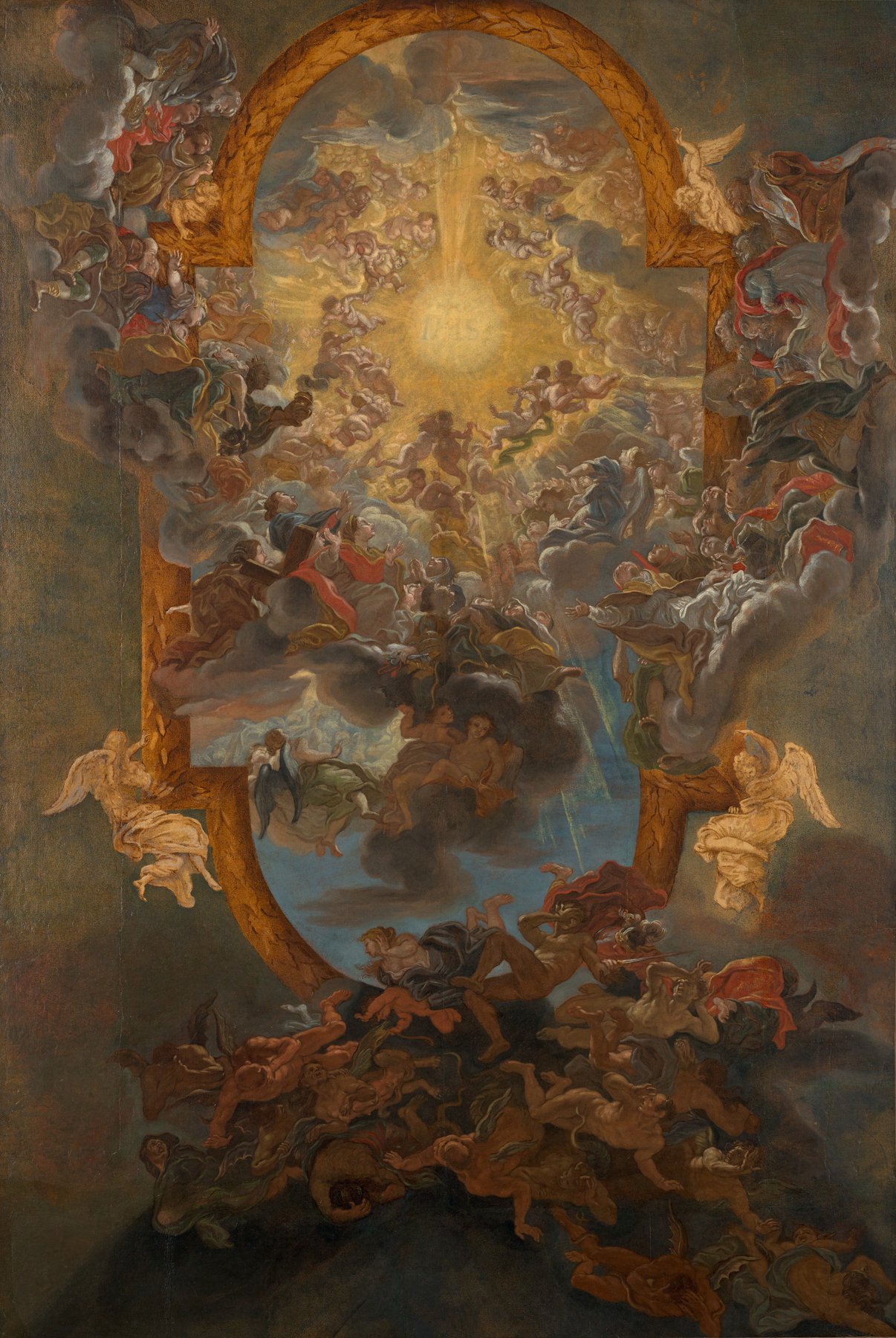
Baciccio (Giovanni Battista Gaulli)
1676–79, Princeton University Art Museum
About this painting
From the readings of the memorial
1If there be therefore any consolation in Christ, if any comfort of charity, if any society of the spirit, if any bowels of commiseration: 2Fulfil ye my joy, that you be of one mind, having the same charity, being of one accord, agreeing in sentiment. 3Let nothing be done through contention: neither by vain glory. But in humility, let each esteem others better than themselves: 4Each one not considering the things that are his own, but those that are other men's. 5For let this mind be in you, which was also in Christ Jesus: 6Who being in the form of God, thought it not robbery to be equal with God: 7But emptied himself, taking the form of a servant, being made in the likeness of men, and in habit found as a man. 8He humbled himself, becoming obedient unto death, even to the death of the cross. 9For which cause, God also hath exalted him and hath given him a name which is above all names: 10That in the name of Jesus every knee should bow, of those that are in heaven, on earth, and under the earth: 11And that every tongue should confess that the Lord Jesus Christ is in the glory of God the Father.
21And after eight days were accomplished, that the child should be circumcised, his name was called JESUS, which was called by the angel before he was conceived in the womb. 22And after the days of her purification, according to the law of Moses, were accomplished, they carried him to Jerusalem, to present him to the Lord: 23As it is written in the law of the Lord: Every male opening the womb shall be called holy to the Lord: 24And to offer a sacrifice, according as it is written in the law of the Lord, a pair of turtledoves or two young pigeons:
Philippians 2:1–11 · Luke 2:21–24, Douay-Rheims (Challoner)
The day in the next three years
| 2027 | Sunday 3 January: not kept this year; in the United States it is the Epiphany of the Lord. |
|---|---|
| 2028 | Monday 3 January |
| 2029 | Wednesday 3 January |
The feasts of the year · The saints · The Rosary
Written and checked by the Monstrance editors; sources cited. Scripture in the Douay-Rheims (Challoner). Each caption follows the record of the institution that holds the work.
Today's masterwork, each morning
One sacred painting a day, chosen by the liturgical calendar and captioned only from the museum's record: the feast, the color of the day, and the Scripture the scene depicts.
One confirmation email first; nothing is sent until you click it. Every email has a one-click unsubscribe, and you can switch to Sundays and feasts only at any time.