The whole Catholic day, delivered as it unfolds — and the paintings that were made for it.
Monstrance App breathes liturgical time through the Catholic year — a prayer companion and a museum of the Church’s masterworks, in one app. It knows the feast, the season and the color of the day before you wake, and if you are building a daily habit of prayer, it walks that path with you: Lauds to Compline, the Rosary, the Chaplet, the Angelus and the Examen, the day’s readings and saint, each beneath a masterwork painted for its hour. The paintings are the thread: what the Church commissioned in Florence and Bruges and Toledo hangs over the prayers a Catholic says this morning, so the ancient Church and the one you belong to are the same Church, seen at once.It is made to be beautiful, because what it prays is.
Hear the bellEmmanuel, the 1685 bourdon of Notre-Dame de Paris, struck once and left to ring out — the sound the app keeps time by.
The app is still being built, and Founding Patrons will be invited in first. The paintings inside it are ready now, as archival prints made to order — that is Monstrance Editions, and it is open today.
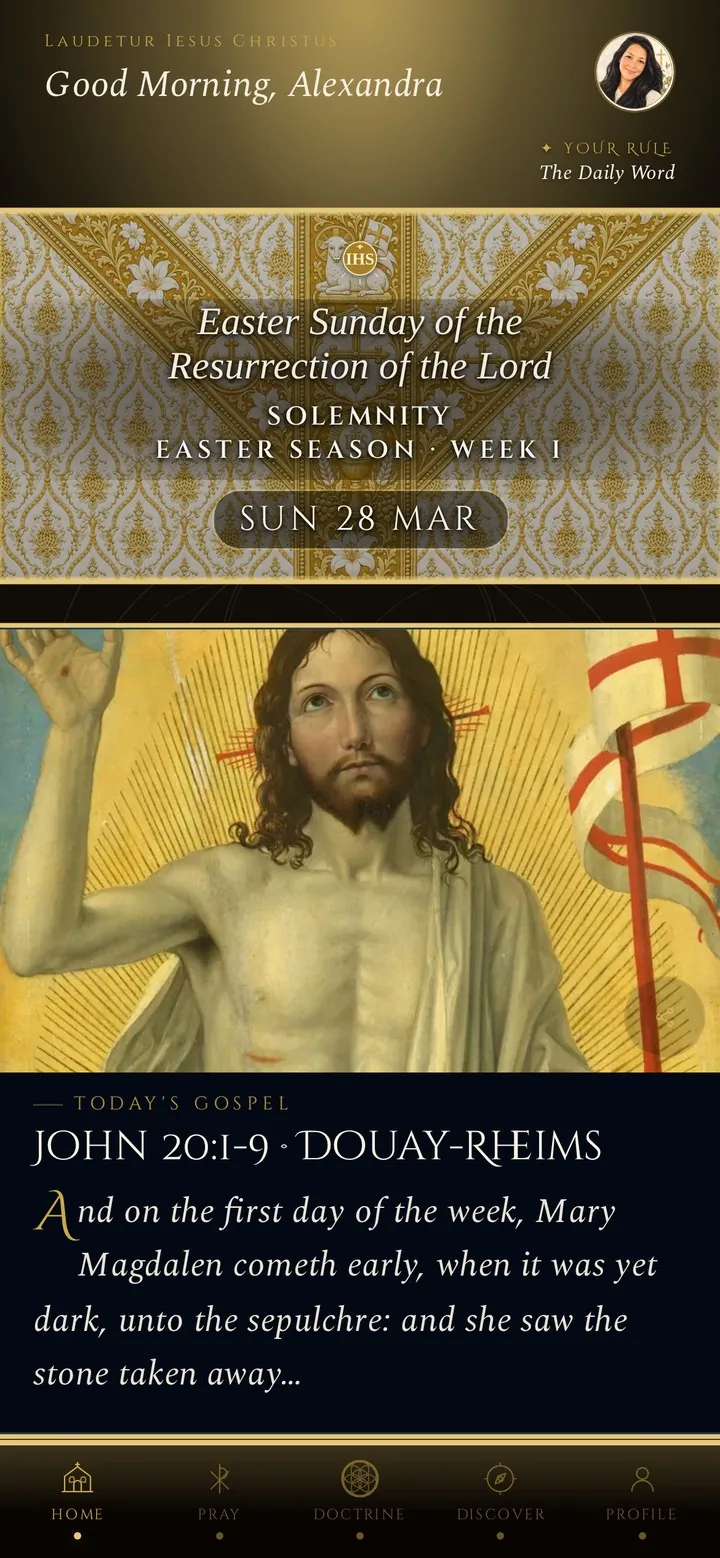
Easter Sunday · 28 March 2027the app, photographed · not a mock-up
Every day, checked.
The feast, the season and the vestment color of all 730 days of 2026 and 2027, verified against the General Instruction of the Roman Missal before every release.
Every answer, cited.
Doctrine answers are composed from the Church’s own texts, and an answer that cannot cite its sources is never shown.
Every print, sourced.
Each edition names its museum and the photograph it is printed from, at that file’s full resolution.
The app · one day, the whole year
From Lauds to Compline, and from Advent to Christ the King.
From first light to the night’s Marian antiphon, the app changes as the hours do — the greeting, the prayer, the painting — and on every day of the year it keeps the feast, the season and the vestment color the Roman Missal gives it. Twelve screens, each photographed from the app itself at the hour and on the day it names — one day’s hours, walked through a whole year’s colors. The swatch beside each is that day’s vestment color; the theme is yours to choose, and the calendar beneath it never changes. Drag the rail, or use the arrow keys.
The app · the liturgical year
One year of grace, every day of it resolved.
The app’s own answer for every day of the liturgical year we are living in, from the First Sunday of Advent: the feast it keeps and the color it wears. Today is marked in gold.
The app · Doctrine
Ask what the Church teaches. Then read where she says it.
Ask in your own words. Monstrance searches the Church’s own writing — the Catechisms, the Councils, the Fathers and the Doctors, and the 1913 Catholic Encyclopedia — and answers from what it finds. Every source it relies on is cited, and every citation opens onto the passage itself, so the last word is never the app’s. When the sources are silent, it says so rather than guessing.
Our Doctrine Corpus contains 32 works and more than 47,000 passages, each weighed by its authority, from the definitions of the Councils to the commentaries of the saints.
A reference, not a teacher. For your soul, see a priest.
Four questions, recorded in the app on 19 September 2026, each in a different theme. The answers are the app’s own, as it gave them; the waits are shortened.
“Is Jesus really present in the Eucharist?”Fortis Virtus · answered from the Council of Trent, Session XIII
Monstrance Editions · a museum-grade collection of the Church’s art
For two thousand years the Church has told her story in paint. Now it can hang where you pray.
Before most Christians could read, they learned the faith from walls. “What writing presents to readers,” Pope St Gregory the Great wrote in the year 600, “this a picture presents to the unlearned who behold.” So the Church painted: the Annunciation above the altar, the Passion down the nave, her saints in the chapel vaults.
Monstrance Editions gathers that inheritance into one collection, and holds it to a museum’s standard rather than a shop’s. 338 paintings and 8 altarpieces by more than 120 masters, from Cimabue, about 1280, to the nineteenth century. Each one is named with the museum that holds it — the Metropolitan, the Louvre, the Prado, the Uffizi — and printed to order from the most detailed image of it we can source, on museum-grade Hahnemühle cotton rag with pigment inks. Nineteen of these works are still in a church, chapel or convent today — among them the Sistine Chapel, the Contarelli Chapel of San Luigi dei Francesi in Rome, the Scrovegni Chapel in Padua and St John’s Co-Cathedral in Valletta.
Eight mysteries
The collection is arranged the way the faith is: by the mystery each painting keeps.
Cimabue to Bouguereau, grouped by the storefront’s own period shelves.
Medieval & Gothic35
Early Renaissance72
Northern Renaissance57
High Renaissance & Mannerism49
Baroque122
Rococo & 18th Century7
19th Century & Beyond7
How large each one prints
A work is offered only in the sizes its photograph can carry at print resolution, so the largest size differs from painting to painting. The size alone sets the price.
Monstrance Editions · Catholic fine-art print store
open today · 338 paintings and 8 altarpieces · made to order
Anyone can say high resolution. Here are the pixels.
Megapixels measure a file, not a picture. So come closer — into the very file we print from and, on two small panels, beneath the Metropolitan Museum’s own microscope.
Monstrance Editions · Catholic fine-art print store · how a print is made
Four decisions behind every print we make.
Monstrance Editions is where the app’s paintings leave the screen: archival prints of the same masterworks you pray with, each made to order. Every sheet we sell has passed these four decisions.
01 · THE FILE
We print from the most detailed file we can source.
Never a web image stretched to fit. Where a museum has published a gigapixel capture, that capture is our master. El Greco’s Agony in the Garden runs 32,015 × 47,508 pixels — a gigapixel and a half — and at least 104 of our masters pass ten thousand pixels on the long edge. Every work is sourced, licensed and cited.
02 · THE PAPER
Cotton rag from a mill founded in 1584.
Every sheet is Hahnemühle Photo Rag: 308 gsm, pure cotton, acid‑free, matte, made in Lower Saxony by a mill that has made paper since 1584 — four years before the Armada. Not a house paper wearing a borrowed name. The paper itself.
03 · THE INK
Pigment, never dye.
Pigment rests on the sheet as ground mineral and carbon; dye soaks in and fades. That is why a pigment print keeps its blacks and its vermilion while a dye print drifts toward amber. Our printer rates its pigment giclées on these papers at 100 to 200 years under good conditions.
04 · THE CUT
A triptych is three pictures, not one.
Most shops flatten an altarpiece into one wide poster, hinges and all. The painter made separate panels, to hang apart with air between them. We cut them as he painted them, sell them as one collection, and size every sheet so the painted figures — not merely the paper — hang level.
Prints from $49 · 8×10 to 40×60 inches · Hahnemühle Photo Rag and pigment inks · shipping included to eight countries · printed, inspected and dispatched within two to four business days · arrived damaged or wrong? Replaced at no cost within fourteen days.
Paper & ink · Shipping · Returns
Monstrance Editions · Catholic fine-art print store · collections
Eight panel sets — altarpieces, triptychs and diptychs — cut as they were painted.
Each collection ships as one order, every sheet sized so the painted figures hang level. The Bosch Garden lands at 0.00% out of level; any collection that misses by more than 6% we decline to sell. See the collections →
For dioceses, parishes and schools
Monstrance for a whole community, and sacred art for the walls it prays within.
Parishes, schools and diocesan offices can bring the app to their people and the collection to their buildings — the app for a whole parish or school, and archival prints for a chapel, a hall or a classroom. Write to us, and we will talk about what your community needs.
Monstrance+ will be $8.99 a month or $59.99 a year, with a seven-day trial, when subscriptions open at launch. The yearly plan is a 44% discount on twelve months at the monthly price. Founding Patrons can instead take it for life for $199, once, with a $59 Monstrance Editions print credit and 20% off every print. There is no launch date to announce yet. The Founding Patron list will hear it first.
Is Monstrance only for Catholics?
It is made by Catholics for the prayer of the Church, and everything in it is Catholic: the calendar, the texts and the art. Anyone curious about how the Church prays, and why, is welcome to pray with it.
Where do the Doctrine answers come from?
Only from the Church’s own texts in the app’s library: thirty-two works and more than forty-seven thousand passages, from the Catechisms and the Councils to the Fathers and Doctors, each weighed by its authority. Every answer shows its sources, and an answer that cannot cite them is not shown. It is a reference, not a teacher. For your soul, see a priest.
How are the prints made and shipped?
Each print is made to order on Hahnemühle Photo Rag with pigment inks, printed in or near your own country, and inspected and dispatched within two to four business days. Shipping is included in the price to the eight countries we serve: the United States, Canada, the United Kingdom, Ireland, Poland, Australia, the Philippines and Mexico.
What if a print arrives damaged?
We replace it. Write to us within fourteen days of delivery with one photograph of the problem, and a replacement is made at no cost; you keep the original and send nothing back. Because every print is made for you, we cannot accept returns for a change of mind.
He is here, and you have come to the right place.
Keep the day the Church keeps. Then hang the picture that was painted for it.