

The Presentation of the Lord
2 February · Feast · White
Simeon, an old man in a red cape, holds the Christ Child on a white cloth over the altar; the Virgin, in blue-green, reaches toward her Son, the prophetess Anna raises her hand behind the altar, and at the left Saint Joseph carries a staff and a wicker cage. The law of Moses let a mother who was not able to offer a lamb bring two turtle doves or two pigeons, and Saint Luke records that offering. The National Gallery of Art gives the painting to the Master of the Prado “Adoration of the Magi”, an anonymous Netherlandish painter, about 1470 to 1480. Forty days after the birth of Christ, Mary complied with the law, redeemed her first-born, and was purified, in the presence of Simeon the just and Anna the prophetess. At Jerusalem a pilgrim of the fourth century found the day kept with a procession to the Constantinian basilica of the Resurrection, a homily on this Gospel, and the Holy Sacrifice; the feast then had no proper name and was simply called the fortieth day after Epiphany. The Emperor Justinian I introduced it in the whole Eastern Empire in 542, in thanksgiving for the cessation of the great pestilence in Constantinople, and the Greeks called it Hypapante, the meeting of the Lord and His Mother with Simeon and Anna. In the West it appears in the Gelasian Sacramentary as the Purification of the Blessed Virgin Mary; Pope Sergius I (687–701) gave the day a procession; the blessing of candles did not come into common use before the eleventh century. The procession with lighted candles represents the entry of Christ, who is the Light of the World, into the Temple of Jerusalem.
Frederick Holweck, “Candlemas”, The Catholic Encyclopedia, vol. 3 (1908): newadvent.org
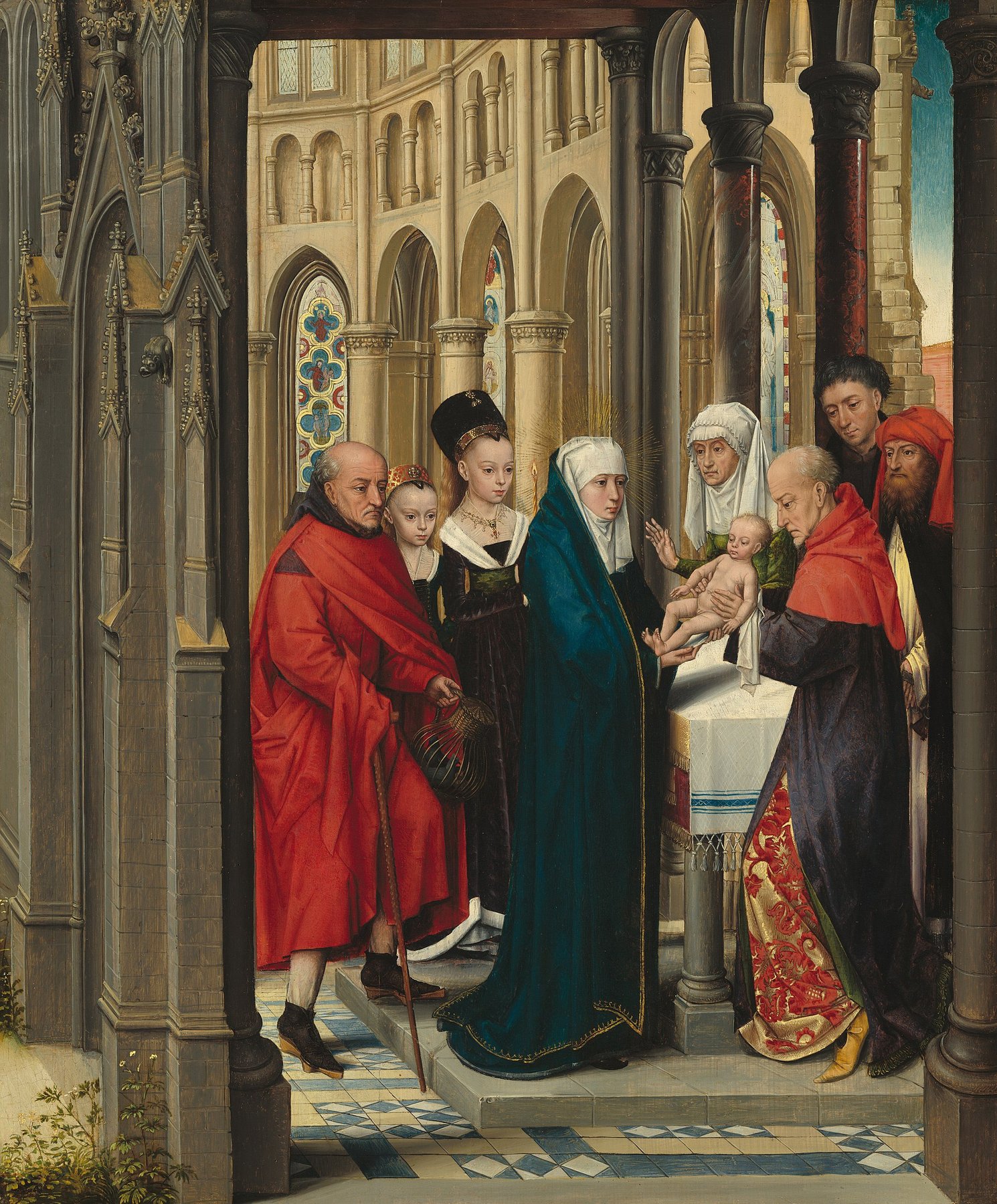
Master of the Prado Adoration of the Magi
c. 1470s, National Gallery of Art, Washington
About this painting
The Gospel of the feast
22And after the days of her purification, according to the law of Moses, were accomplished, they carried him to Jerusalem, to present him to the Lord: 23As it is written in the law of the Lord: Every male opening the womb shall be called holy to the Lord: 24And to offer a sacrifice, according as it is written in the law of the Lord, a pair of turtledoves or two young pigeons: 25And behold there was a man in Jerusalem named Simeon: and this man was just and devout, waiting for the consolation of Israel. And the Holy Ghost was in him. 26And he had received an answer from the Holy Ghost, that he should not see death before he had seen the Christ of the Lord. 27And he came by the Spirit into the temple. And when his parents brought in the child Jesus, to do for him according to the custom of the law, 28He also took him into his arms and blessed God and said 29Now thou dost dismiss thy servant, O Lord, according to thy word in peace: 30Because my eyes have seen thy salvation, 31Which thou hast prepared before the face of all peoples: 32A light to the revelation of the Gentiles and the glory of thy people Israel.
Luke 2:22–32, Douay-Rheims (Challoner)
The day in the next three years
| 2027 | Tuesday 2 February |
|---|---|
| 2028 | Wednesday 2 February |
| 2029 | Friday 2 February |
The feasts of the year · The saints · The Rosary
Written and checked by the Monstrance editors; sources cited. Scripture in the Douay-Rheims (Challoner). Each caption follows the record of the institution that holds the work.
Today's masterwork, each morning
One sacred painting a day, chosen by the liturgical calendar and captioned only from the museum's record: the feast, the color of the day, and the Scripture the scene depicts.
One confirmation email first; nothing is sent until you click it. Every email has a one-click unsubscribe, and you can switch to Sundays and feasts only at any time.