

Saint Agnes, Virgin and Martyr
21 January · Memorial · Red
Saint Agnes stands at the lower right in red and holds a lamb, and Saint Martina stands opposite with a palm and a lion, beneath the Virgin and the Christ Child in the clouds. El Greco painted it for the Capilla de San José in Toledo, which commissioned it on 9 November 1597. Of all the virgin martyrs of Rome none was held in such high honour by the early Church as Agnes. The Roman calendar of the martyrs of 354 assigns her feast to 21 January and names the road near her grave, the Via Nomentana. Saint Ambrose gives her age as twelve and Saint Augustine as thirteen. On her youth the early witnesses agree; on the details of her death they differ, and the Catholic Encyclopedia says that at the end of the fourth century no accurate and reliable narrative of them existed. Ambrose tells of her death by the sword; Pope Damasus, in verses engraved on marble at the foot of the stairs to her tomb, says that she suffered the martyrdom of fire and veiled her body with her flowing hair. Ambrose wrote of her: “Behold therefore in the same victim a double martyrdom, one of modesty, the other of religion.” Through the efforts of Constantina, the daughter of Constantine, a basilica was raised over her grave; Pope Honorius (625–638) later remodelled it entirely, and in its apse a mosaic shows her amid flames with a sword at her feet. Since the Middle Ages she has been shown with a lamb, the symbol of her virginal innocence; on her feast two lambs are solemnly blessed, and from their wool are made the palliums the Pope sends to archbishops.
Johann Peter Kirsch, “St. Agnes of Rome”, The Catholic Encyclopedia, vol. 1 (1907): newadvent.org
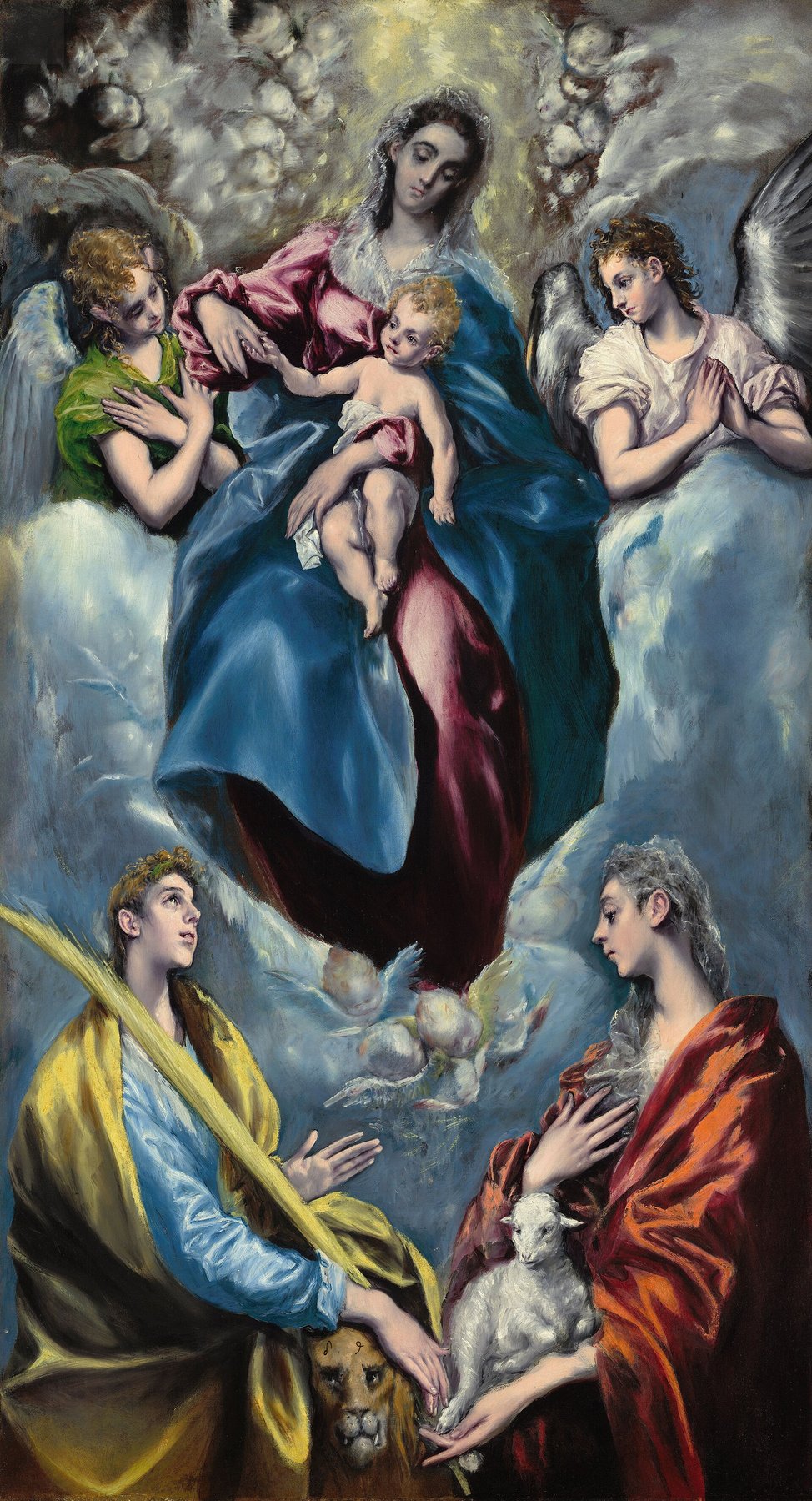
El Greco
1597–1599, National Gallery of Art, Washington
About this painting
From the readings of the memorial
26For see your vocation, brethren, that there are not many wise according to the flesh, not many mighty, not many noble. 27But the foolish things of the world hath God chosen, that he may confound the wise: and the weak things of the world hath God chosen, that he may confound the strong. 28And the base things of the world and the things that are contemptible, hath God chosen: and things that are not, that he might bring to nought things that are: 29That no flesh should glory in his sight. 30But of him are you in Christ Jesus, who of God is made unto us wisdom and justice and sanctification and redemption: 31That, as it is written: He that glorieth may glory in the Lord.
44The kingdom of heaven is like unto a treasure hidden in a field. Which a man having found, hid it, and for joy thereof goeth, and selleth all that he hath, and buyeth that field. 45Again the kingdom of heaven is like to a merchant seeking good pearls. 46Who when he had found one pearl of great price, went his way, and sold all that he had, and bought it.
1 Corinthians 1:26–31 · Matthew 13:44–46, Douay-Rheims (Challoner)
The day in the next three years
| 2027 | Thursday 21 January |
|---|---|
| 2028 | Friday 21 January |
| 2029 | Sunday 21 January: not kept this year; it is the Third Sunday in Ordinary Time. |
The feasts of the year · The saints · The Rosary
Written and checked by the Monstrance editors; sources cited. Scripture in the Douay-Rheims (Challoner). Each caption follows the record of the institution that holds the work.
Today's masterwork, each morning
One sacred painting a day, chosen by the liturgical calendar and captioned only from the museum's record: the feast, the color of the day, and the Scripture the scene depicts.
One confirmation email first; nothing is sent until you click it. Every email has a one-click unsubscribe, and you can switch to Sundays and feasts only at any time.