Saint Gregory the Great, Pope and Doctor
3 September · Memorial · White
Below the Virgin in glory four saints stand two by two, and Saint Gregory the Great is among them, with Saint John the Baptist, Saint Benedict and Saint Jerome; Andrea Mantegna painted the altarpiece in 1497 for Santa Maria in Organo in Verona. Gregory was born in Rome about 540, the son of Gordianus, a wealthy patrician, and of Silvia, whom the Church honours as a saint. He was Prefect of Rome by about 573, when he was little more than thirty; soon after, probably in 574, he made his family's house on the Caelian Hill into a monastery under Saint Andrew and took the habit there. Pope Pelagius II sent him to the imperial court at Constantinople in 579 as his permanent envoy, and he stayed about six years. When Pelagius died in February 590, in a year of flood and pestilence, the clergy and people of Rome elected Gregory; he led a sevenfold procession of the city to the Basilica of the Blessed Virgin, and he was consecrated at Saint Peter's on 3 September 590, the day on which the Church now keeps his memorial. He wrote the Moralia on Job, the Pastoral Rule on the office of a bishop, the Dialogues, homilies on Ezechiel and on the Gospels, and fourteen books of letters, among them the two on sacred images below. The Catholic Encyclopedia calls him rightly the Apostle of the English. He died on 12 March 604 and was buried the same day in the portico of Saint Peter's.
Gilbert Huddleston, “Pope St. Gregory I (the Great)”, The Catholic Encyclopedia, vol. 6 (1909): newadvent.org
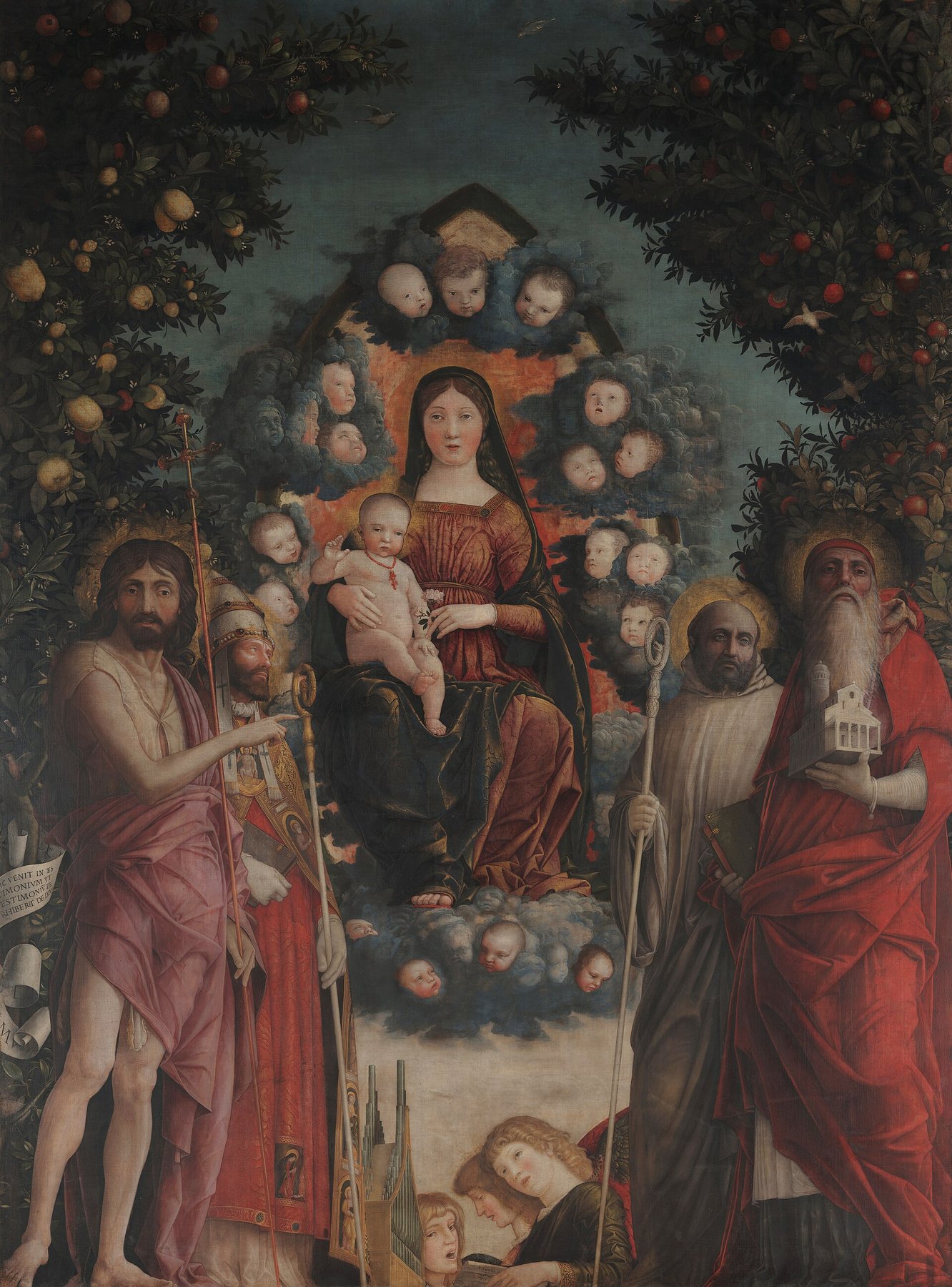
Andrea Mantegna
1497, Castello Sforzesco, Milan
About this painting
On sacred images
About the year 599, Serenus, Bishop of Marseilles, saw people adoring the pictures in his churches and had them broken. Gregory wrote to him in July 599:
For pictorial representation is made use of in Churches for this reason; that such as are ignorant of letters may at least read by looking at the walls what they cannot read in books. Your Fraternity therefore should have both preserved the images and prohibited the people from adoration of them…
Registrum IX.209 (NPNF IX.105), trans. James Barmby, 1898
Serenus doubted that the letter was genuine. In October 600 Gregory wrote to him again:
For to adore a picture is one thing, but to learn through the story of a picture what is to be adored is another. For what writing presents to readers, this a picture presents to the unlearned who behold, since in it even the ignorant see what they ought to follow; in it the illiterate read. … But let thy Fraternity carefully admonish them that from the sight of the event portrayed they should catch the ardour of compunction, and bow themselves down in adoration of the One Almighty Holy Trinity.
Registrum XI.10 (NPNF XI.13), trans. James Barmby, 1898 · Aliud est enim picturam adorare, aliud per picturae historiam quid sit adorandum addiscere.
Every painting in Monstrance is here for the reason he gave.
The feasts of the year · The saints · The Rosary
Today's masterwork, each morning
One sacred painting a day, chosen by the liturgical calendar and captioned only from the museum's record: the feast, the color of the day, and the Scripture the scene depicts.
One confirmation email first; nothing is sent until you click it. Every email has a one-click unsubscribe, and you can switch to Sundays and feasts only at any time.