
Saint Nicholas, Bishop
6 December · Optional Memorial · White
Pilgrims crowd the steps of a stone tomb raised on columns, and two of them reach up with both hands to touch it; in front two men carry a sick companion between them, the man in yellow holding him by the arms and the man in green by the legs, and at the right a man with a wounded shin comes in on a cane. The tomb is Saint Nicholas's, and Gentile da Fabriano painted it in 1425 for the predella of the Quaratesi altarpiece. Nicholas was Bishop of Myra in Lycia in the fourth century, and the Catholic Encyclopedia, which gives his death as 6 December, 345 or 352, says that scarcely anything else about him is historically certain. Among the main points of his legend is that he was cast into prison under Diocletian and released after the accession of Constantine. His cult in the Greek Church is old: as early as the sixth century the Emperor Justinian I built a church in his honour at Constantinople, and his name occurs in the liturgy ascribed to Saint John Chrysostom. In 1087 Italian merchants stole his body at Myra and brought it to Bari, and his relics are still kept in the church of San Nicola there. He is the patron of mariners, merchants, bakers, travellers and children, and in Germany, Switzerland and the Netherlands he became the secret bringer of gifts to children on 6 December, the day on which the Church keeps his feast. In the painting the sick have come into the church to his tomb, and at the left one walks away from it with his crutch across his shoulder.
Michael Ott, “St. Nicholas of Myra”, The Catholic Encyclopedia, vol. 11 (1911): newadvent.org
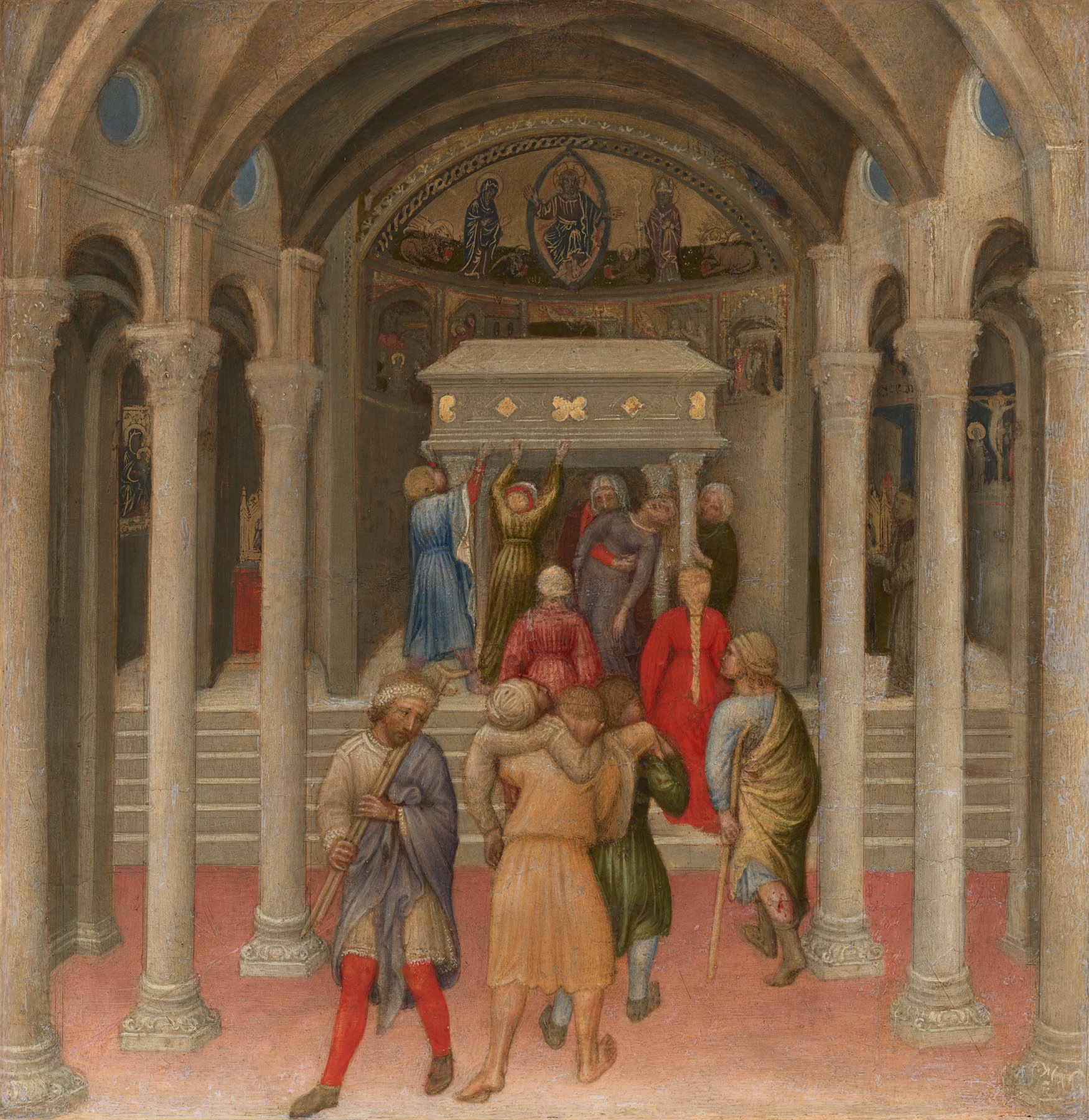
Gentile da Fabriano
1425, National Gallery of Art, Washington
About this painting
From the readings of the memorial
1In the year that king Ozias died, I saw the Lord sitting upon a throne high and elevated: and his train filled the temple. 2Upon it stood the seraphims: the one had six wings, and the other had six wings: with two they covered his face, and with two they covered his feet, and with two they flew. 3And they cried one to another, and said: Holy, holy, holy, the Lord God of hosts, all the earth is full of his glory, 4And the lintels of the doors were moved at the voice of him that cried, and the house was filled with smoke. 5And I said: Woe is me, because I have held my peace; because I am a man of unclean lips, and I dwell in the midst of a people that hath unclean lips, and I have seen with my eyes the King the Lord of hosts. 6And one of the seraphims flew to me, and in his hand was a live coal, which he had taken with the tongs off the altar. 7And he touched my mouth, and said: Behold this hath touched thy lips, and thy iniquities shall be taken away, and thy sin shall be cleansed. 8And I heard the voice of the Lord, saying: Whom shall I send? and who shall go for us? And I said: Lo, here am I, send me.
1And after these things, the Lord appointed also other seventy-two. And he sent them two and two before his face into every city and place whither he himself was to come. 2And he said to them: The harvest indeed is great, but the labourers are few. Pray ye therefore the Lord of the harvest that he send labourers into his harvest. 3Go: Behold I send you as lambs among wolves. 4Carry neither purse, nor scrip, nor shoes: and salute no man by the way. 5Into whatever house you enter, first say: Peace be to this house. 6And if the son of peace be there, your peace shall rest upon him: but if not, it shall return to you. 7And in the same house, remain, eating and drinking such things as they have: for the labourer is worthy of his hire. Remove not from house to house. 8And into what city soever you enter, and they receive you, eat such things as are set before you. 9And heal the sick that are therein and say to them: The kingdom of God is come nigh unto you.
Isaias 6:1–8 · Luke 10:1–9, Douay-Rheims (Challoner)
The day in the next three years
| 2026 | Sunday 6 December: not kept this year; it is the Second Sunday of Advent. |
|---|---|
| 2027 | Monday 6 December |
| 2028 | Wednesday 6 December |
The feasts of the year · The saints · The Rosary
Written and checked by the Monstrance editors; sources cited. Scripture in the Douay-Rheims (Challoner). Each caption follows the record of the institution that holds the work.
Today's masterwork, each morning
One sacred painting a day, chosen by the liturgical calendar and captioned only from the museum's record: the feast, the color of the day, and the Scripture the scene depicts.
One confirmation email first; nothing is sent until you click it. Every email has a one-click unsubscribe, and you can switch to Sundays and feasts only at any time.