

Saints Fabian and Sebastian, Martyrs
20 January · Optional Memorials · Red
Saint Sebastian, bound to a post and pierced with arrows, lifts his eyes, while Irene, kneeling at the left in green, unties the rope at his wrist; a servant on a ladder reaches up to the cord on the post, and an angel in blue holds the drawn arrows. Melchior de la Mars painted it about 1620 to 1625. Little more than the fact of his martyrdom can be proved about Saint Sebastian: the Depositio martyrum of the chronologer of 354 says that he was buried on the Via Appia, and Saint Ambrose states that he came from Milan and was venerated there. His Acts, probably written at the beginning of the fifth century, make him an officer of the imperial bodyguard, shot by archers, healed by the widowed Saint Irene and at last killed by the blows of a club; the Catholic Encyclopedia judges these stories unhistorical. The earliest mosaic of him, probably of the year 682, shows a grown, bearded man in court dress with no trace of an arrow; it was the art of the Renaissance that first portrayed him as a youth pierced by arrows. In 367 a basilica, one of the seven chief churches of Rome, was built over his grave, and he is invoked against the plague. Fabian, who shares his day, was Pope from 236 to 250; Eusebius relates that at the election a dove suddenly descended upon his head, and the brethren chose him with joyous unanimity. Fabian died a martyr on 20 January 250, at the beginning of the Decian persecution, and was buried in the Crypt of the Popes in the catacomb of Saint Callistus, where in 1850 De Rossi found his Greek epitaph: “Fabian, bishop and martyr.”
Klemens Löffler, “St. Sebastian”, The Catholic Encyclopedia, vol. 13 (1912): newadvent.org
Gabriel Meier, “Pope St. Fabian”, The Catholic Encyclopedia, vol. 5 (1909): newadvent.org
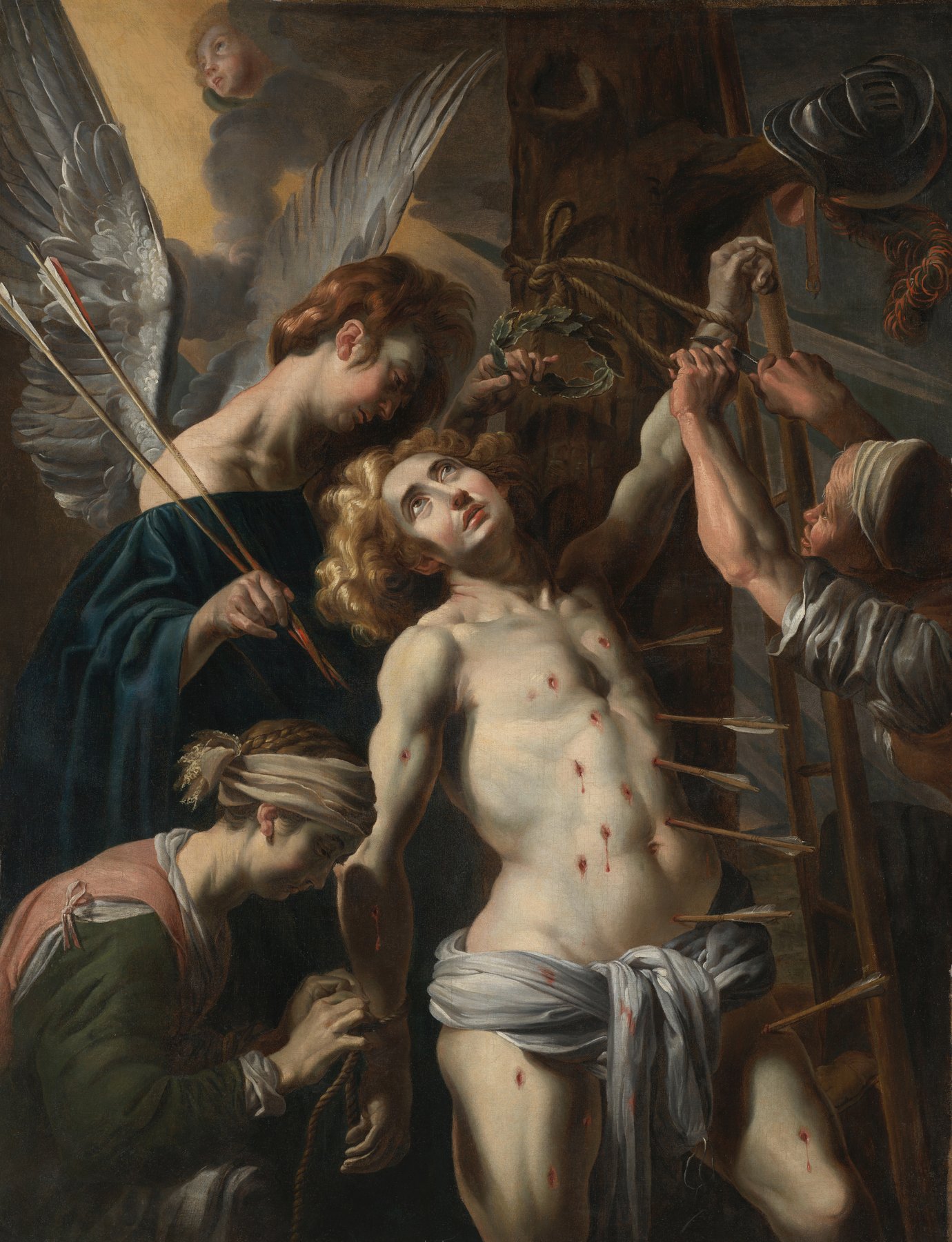
Melchior de la Mars
c. 1620–1625, Museum of Fine Arts (MSK), Ghent
About this painting
From the readings for Saint Fabian
1The ancients therefore that are among you, I beseech who am myself also an ancient and a witness of the sufferings of Christ, as also a partaker of that glory which is to be revealed in time to come: 2Feed the flock of God which is among you, taking care of it, not by constraint but willingly, according to God: not for filthy lucre's sake but voluntarily: 3Neither as lording it over the clergy but being made a pattern of the flock from the heart. 4And when the prince of pastors shall appear, you shall receive a never fading crown of glory.
15When therefore they had dined, Jesus saith to Simon Peter: Simon, son of John, lovest thou me more than these? He saith to him: Yea, Lord, thou knowest that I love thee. He saith to him: Feed my lambs. 16He saith to him again: Simon, son of John, lovest thou me? He saith to him: yea, Lord, thou knowest that I love thee. He saith to him: Feed my lambs. 17He said to him the third time: Simon, son of John, lovest thou me? Peter was grieved because he had said to him the third time: Lovest thou me? And he said to him: Lord, thou knowest all things: thou knowest that I love thee. He said to him: Feed my sheep.
1 Peter 5:1–4 · John 21:15–17, Douay-Rheims (Challoner)
From the readings for Saint Sebastian
14But if also you suffer any thing for justice' sake, blessed are ye. And be not afraid of their fear: and be not troubled. 15But sanctify the Lord Christ in your hearts, being ready always to satisfy every one that asketh you a reason of that hope which is in you. 16But with modesty and fear, having a good conscience: that whereas they speak evil of you, they may be ashamed who falsely accuse your good conversation in Christ. 17For it is better doing well (if such be the will of God) to suffer than doing ill.
28And fear ye not them that kill the body, and are not able to kill the soul: but rather fear him that can destroy both soul and body in hell. 29Are not two sparrows sold for a farthing? and not one of them shall fall on the ground without your Father. 30But the very hairs of your head are all numbered. 31Fear not therefore: better are you than many sparrows. 32Every one therefore that shall confess me before men, I will also confess him before my Father who is in heaven. 33But he that shall deny me before men, I will also deny him before my Father who is in heaven.
1 Peter 3:14–17 · Matthew 10:28–33, Douay-Rheims (Challoner)
In painting
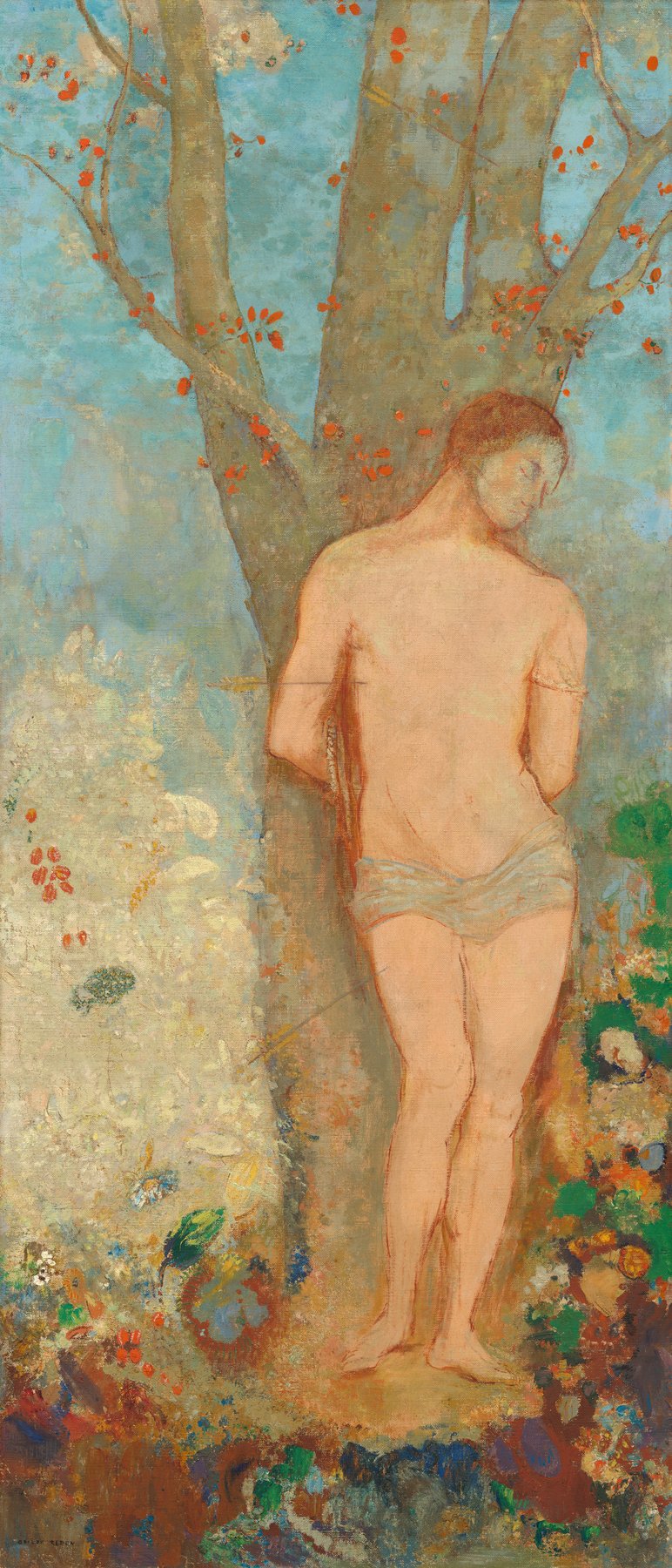
Odilon Redon
1910/1912, National Gallery of Art, Washington
About this painting
The day in the next three years
| 2027 | Wednesday 20 January |
|---|---|
| 2028 | Thursday 20 January |
| 2029 | Saturday 20 January |
The feasts of the year · The saints · The Rosary
Written and checked by the Monstrance editors; sources cited. Scripture in the Douay-Rheims (Challoner). Each caption follows the record of the institution that holds the work.
Today's masterwork, each morning
One sacred painting a day, chosen by the liturgical calendar and captioned only from the museum's record: the feast, the color of the day, and the Scripture the scene depicts.
One confirmation email first; nothing is sent until you click it. Every email has a one-click unsubscribe, and you can switch to Sundays and feasts only at any time.