Saint Martin of Tours
11 November · Memorial · White
On a white horse that lifts its foreleg, a young soldier in gilt and black armour cuts his green cloak with his sword, and a tall, gaunt beggar, a white bandage at one ankle, holds the cloth to himself and looks up. El Greco painted the story Sulpicius Severus tells. In the middle of a hard winter a young soldier of the imperial guard met at the gate of Amiens a man with nothing on. He had already given away everything but his cloak, so he drew his sword, cut it in two and gave away half, and some of those watching laughed at him. That night Christ came to him in a dream wearing the half he had given and said to the angels standing round Him: “Martin, who is still but a catechumen, clothed me with this robe.” He gave away half of what kept him warm, and was told he had dressed his Lord.
Sulpicius Severus, Life of St. Martin (c. 396), trans. Alexander Roberts, Nicene and Post-Nicene Fathers, 2nd series, vol. 11 (1894): newadvent.org, ch. 3
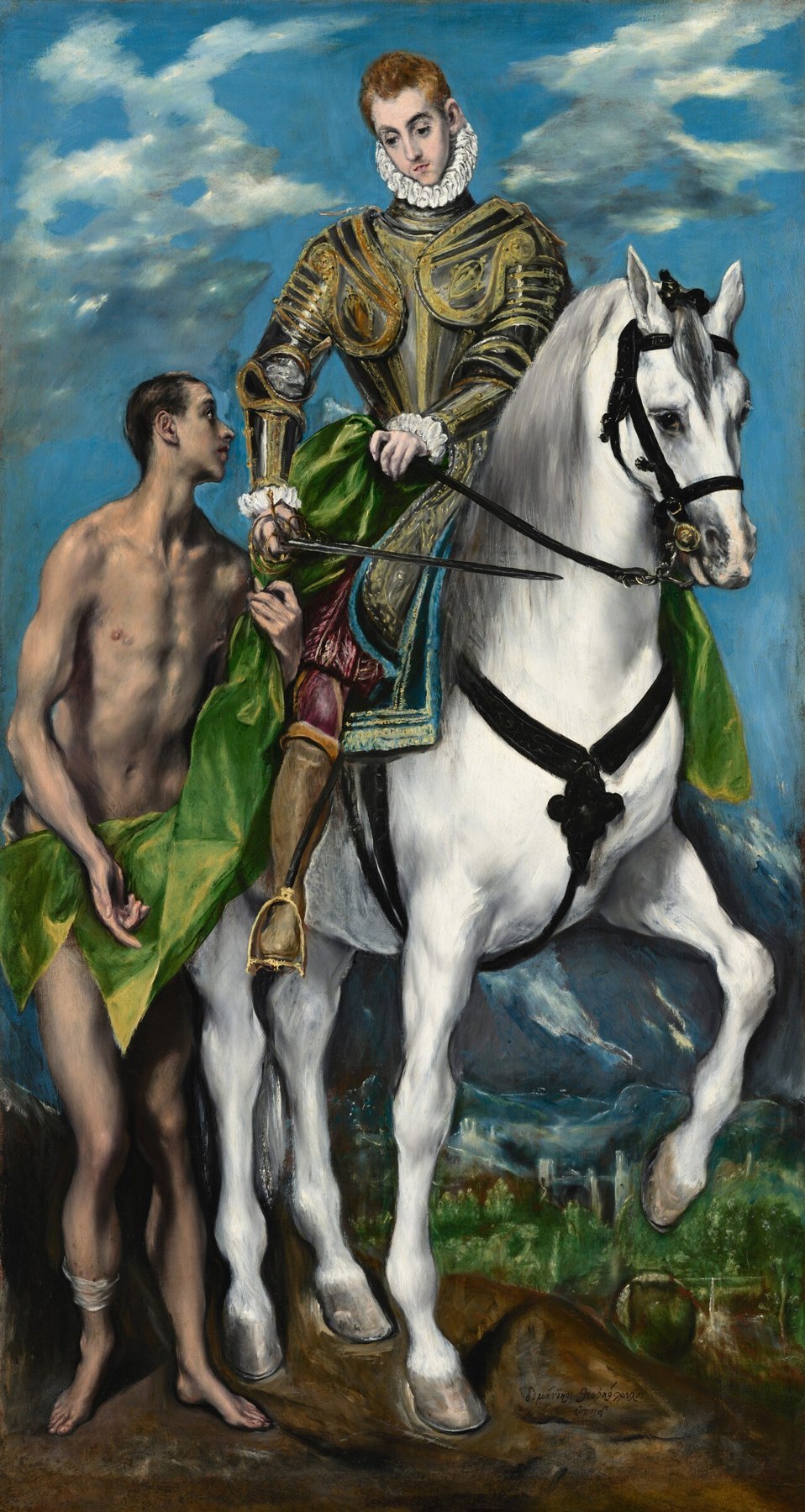
El Greco
1597/1599, oil on canvas, National Gallery of Art, Washington, 1942.9.25
The holding institution's record
His life
He was born at Sabaria in Pannonia, today Szombathely in Hungary, about the year 316, and grew up at Pavia, the son of a military tribune. At ten he went to church against his parents' wishes and asked to be made a catechumen; at fifteen an imperial edict on the sons of veterans compelled him to take the military oath. After Amiens he was baptised. Before a battle near Worms he asked to leave the army, and when the emperor Julian called it cowardice he offered to stand in the front line the next day with no weapon but the sign of the cross. The enemy sent to ask for peace before the battle could be fought.
Free of the army, he went to Saint Hilary at Poitiers, and about 361 settled at Ligugé, where a community of monks gathered round him. In 371 or 372 the people of Tours wanted him for their bishop; he had to be drawn into the city on the excuse of a sick woman who needed him. He lived on as a monk at Marmoutier outside the walls, in a cell of wood, and went out through central and western Gaul to preach to people who had never heard the Gospel. Sulpicius Severus, who knew him and wrote his life before he died, tells of the sick healed and the dead raised. He died at Candes in 397 and his body was carried back to Tours; his feast is kept on 11 November.
The cloak itself became a relic. The Frankish kings kept Martin's cappa and carried it with them; the tent that sheltered it on campaign was called the capella, and the priests who said Mass in it the capellani. Every chapel and every chaplain since takes the name from his half of a cloak.
Sulpicius Severus, Life of St. Martin (c. 396), trans. Alexander Roberts, Nicene and Post-Nicene Fathers, 2nd series, vol. 11 (1894): newadvent.org, chs. 2–10; Catholic Encyclopedia, vol. 9 (1910), “St. Martin of Tours”, and vol. 3 (1908), “Chapel”: newadvent.org
“I am the soldier of Christ: it is not lawful for me to fight.”
Martin to the emperor Julian, before Worms: Sulpicius Severus, Life of St. Martin (c. 396), trans. Alexander Roberts, Nicene and Post-Nicene Fathers, 2nd series, vol. 11 (1894): newadvent.org, ch. 4
In Scripture
35For I was hungry, and you gave me to eat: I was thirsty, and you gave me to drink: I was a stranger, and you took me in: 36Naked, and you covered me: sick, and you visited me: I was in prison, and you came to me.
40And the king answering shall say to them: Amen I say to you, as long as you did it to one of these my least brethren, you did it to me.
Matthew 25:35–36 · Matthew 25:40, Douay-Rheims (Challoner). Sulpicius ties the dream to these words.
In painting
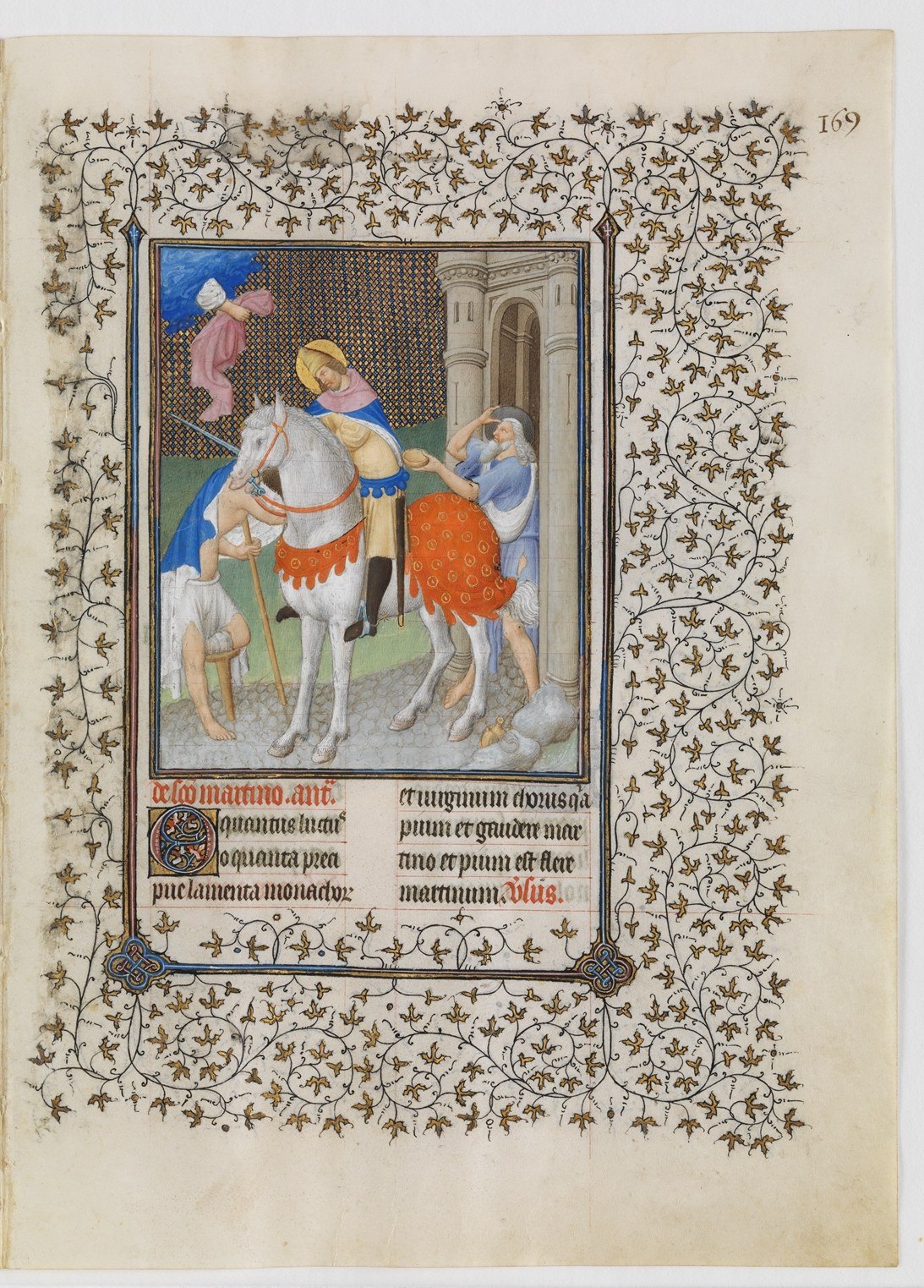
The Limbourg Brothers
1405–1408/9, Belles Heures of Jean de France, duc de Berry, fol. 169r, The Metropolitan Museum of Art, The Cloisters, 54.1.1a, b
The Met's page for this folio
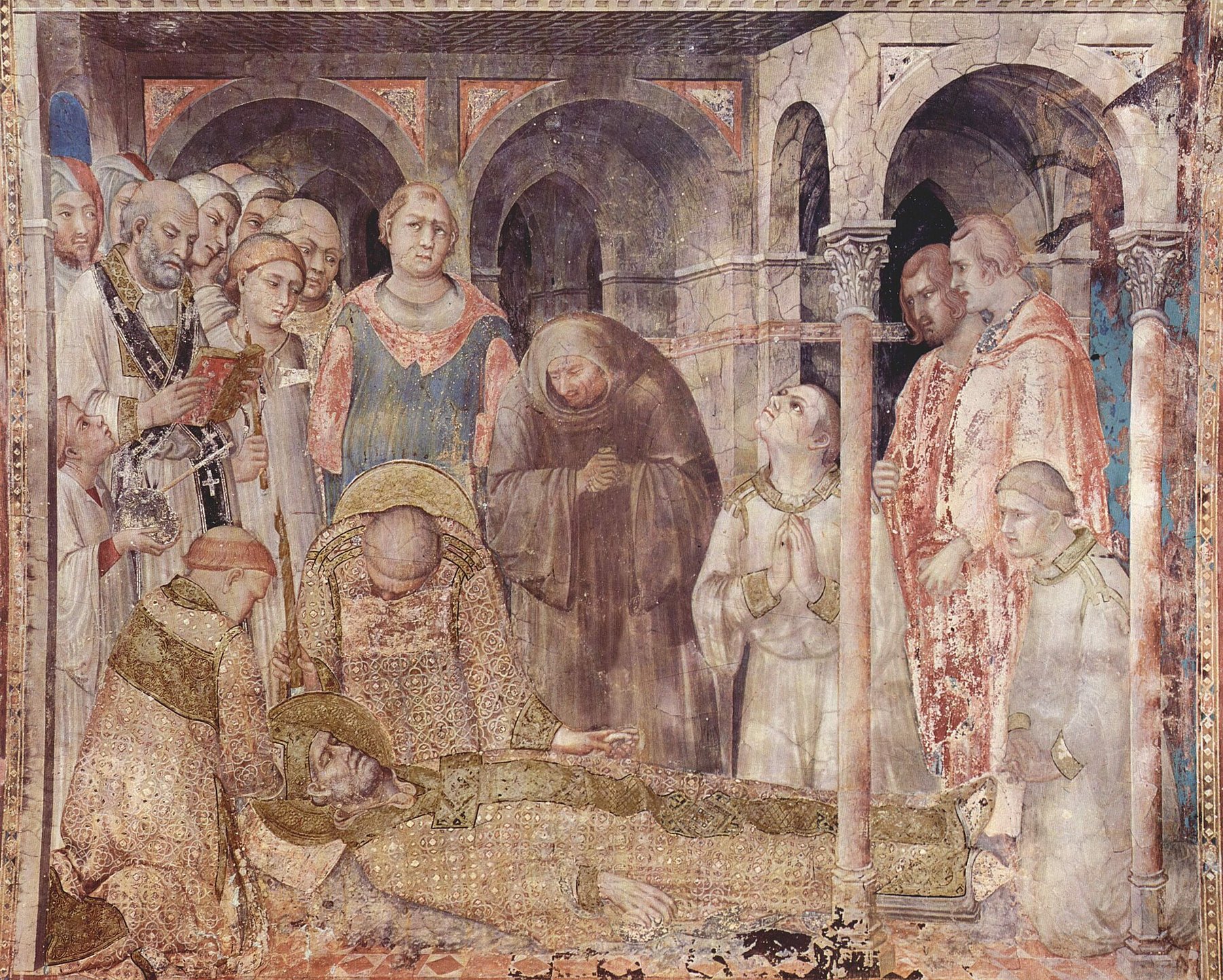
Simone Martini
1313–1318, Basilica di San Francesco di Assisi
About this painting
In the Belles Heures the blue half falls over a beggar who keeps his face hidden; what shows of him, the Met notes, is a bandaged stump of leg on a wooden prop. The Limbourg brothers lay the cobbles and the city gate stone by stone, then set behind them a ground of gold tiles, and out of one patch of blue sky the hand of God reaches down.
High on the wall of his chapel at Assisi the old bishop lies in gold vestments and the living lean over him: a friar with folded hands, a priest reading from a red book, a boy with the censer, and a young server who lifts his face to look up.
The day in the next three years
| 2026 | Wednesday 11 November |
|---|---|
| 2027 | Thursday 11 November |
| 2028 | Saturday 11 November |
Keeping the day
To keep his day, give away something you still use: a coat, a pair of shoes, a meal from your own plate. Martin cut the cloak he was wearing.
Near this day
The saints of the year · The feasts · The Rosary
Written and checked by the Monstrance editors; sources cited. Scripture in the Douay-Rheims (Challoner). Every painting is in the public domain, and each caption follows the record of the institution that holds it.
Today's masterwork, each morning
One sacred painting a day, chosen by the liturgical calendar and captioned only from the museum's record: the feast, the colour of the day, and the Scripture the scene depicts.
One confirmation email first; nothing is sent until you click it. Every email has a one-click unsubscribe, and you can switch to Sundays and feasts only at any time.