Drag the print to move it. Shown at true scale; prints are sold unframed, and a frame here is only for planning.
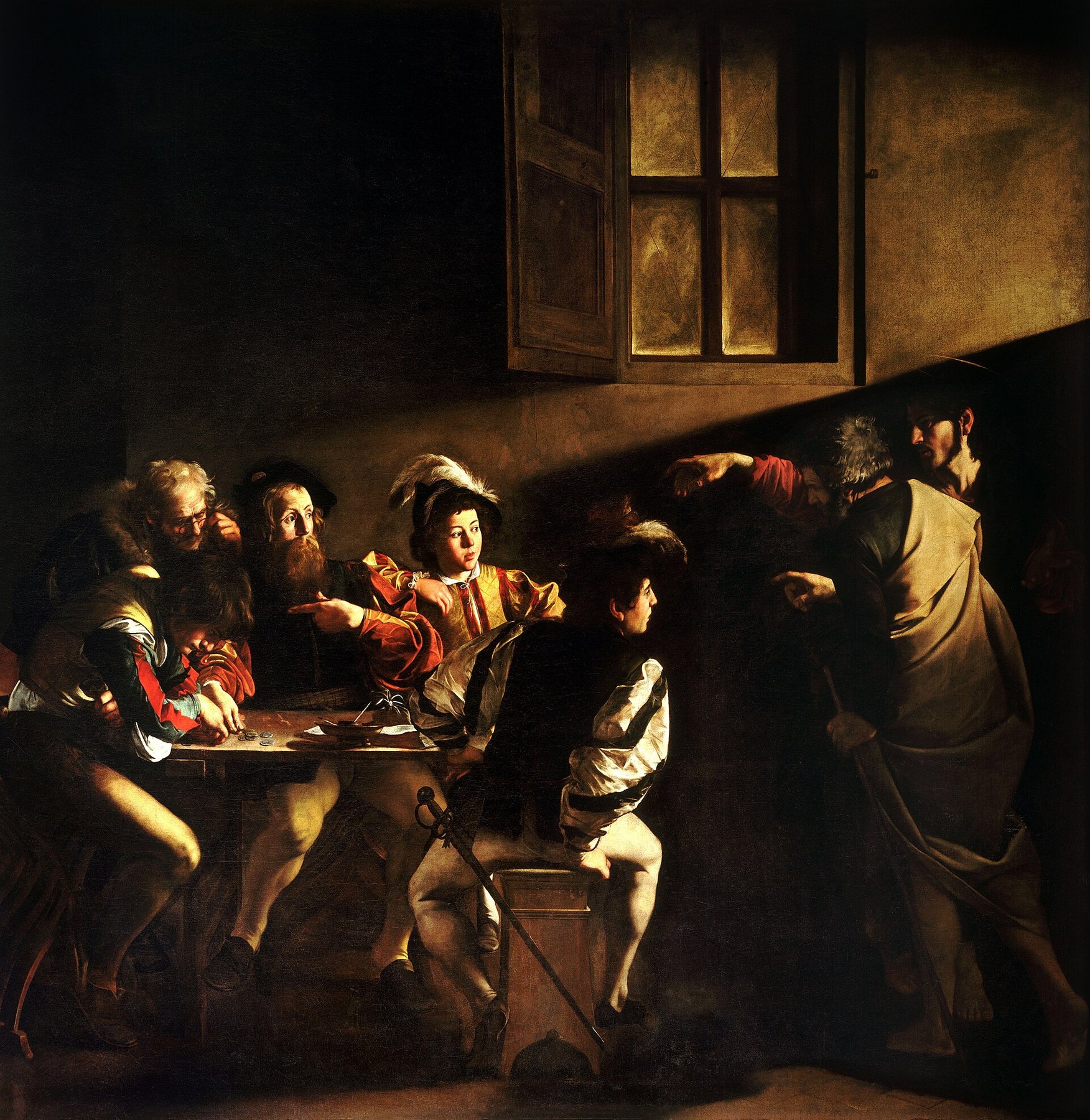
The Calling of St Matthew
1599–1600 · Saint-Louis-des-Français / San Luigi dei Francesi, Roma
Sizes
What is dpi?
Dots per inch: how many pixels of the museum’s file go into each inch of paper. Our floor is 240 for sheets up to 20 inches, 180 up to 36 inches and 120 beyond, because a larger print is seen from further away. We never offer a sheet below the floor, and the number on each size is the one you receive.
Printed to order · the whole painting, never cropped · if it arrives damaged, we replace it
Free shipping, included in the price, to all eight countries we ship to. Dispatched in 2–4 working days — nothing to send back if it arrives damaged.
Send as a gift
A printed card goes in the parcel with your message and the work’s museum record. No price is shown anywhere in the parcel. Enter the recipient’s address at checkout.
0 / 240Have a gift certificate?
The certificate’s balance is applied at checkout; any remainder is paid there. Check a balance or buy one.
Christmas: order by Monday 7 December for delivery in the United States before Christmas.
All editionsAbout this painting
Christ's hand comes out of the dark and points across a table of coins. Irving Lavin reads it as Adam's hand from the Sistine ceiling, reversed: Christ as the New Adam. Smarthistory traces the light to a source above His head that Caravaggio will not show, and Gozzano and Tosini tie it to the chapel's own window; the window he does paint lets nothing in. At the table young men in feathers and silk turn to look. Which of them is Matthew, art historians have argued since Andreas Prater in 1985, and still argue. Someone at that table is about to stand up.
Sources: Irving Lavin, "Caravaggio’s Calling of St. Matthew: The Identity of the Protagonist," in Past-Present (UC Press, 1993), 84-99 · Andreas Prater, Pantheon (1985); Jürgen Müller, Kunstgeschichte OPRJ (2021), DOI 10.5283/kuge.577 · the beam from an unseen source above Christ’s head; contemporary dress against timeless robes · citing Gozzano & Tosini, La cappella Contarelli in San Luigi dei Francesi
And when Jesus passed on from thence, he saw a man sitting in the custom house, named Matthew; and he saith to him: Follow me. And he arose up and followed him.
Matthew 9:9 · Douay-Rheims (Challoner)
The Record
The original, as its museum records it
Every line above is reproduced from the holding institution’s own catalogue entry, which is linked. Where their title, date or attribution differs from ours, theirs is the one printed here.
The file this print is made from
| Artist | Caravaggio (Italian, 1571–1610) |
|---|---|
| Date | 1599–1600 |
| Museum | Saint-Louis-des-Français / San Luigi dei Francesi, Roma |
| Sheet sizes | 18×24 in, 24×36 in, 32×48 in, 40×60 in |
| Held by | Saint-Louis-des-Français / San Luigi dei Francesi, Roma the museum’s record |
|---|---|
| Source file | Wikimedia Commons · The Calling of Saint Matthew-Caravaggo (1599-1600).jpg |
| Licence | Public domain |
| Master | 9,770 × 10,039 px, the file our printer receives |
| Chain | Taken from Wikimedia Commons; held as our print master. |
The sheets
Printed on demand. Public-domain masterwork, reproduced from a 10,039 px master of the original. The whole image is printed — never cropped to fit the sheet — so every sheet carries an archival margin, and the dimensions and resolution listed above are the ones you receive.