Saint Charles Borromeo
4 November · Memorial · White
Charles Borromeo is seen in profile, the long hooked nose and the biretta set against a dark ground inside an engraved octagon. Jean Morin, engraving Philippe de Champaigne's portrait, letters around it his name, his title as cardinal and archbishop of Milan, and two years: born 1538, died 1584. Between them a city was taught its catechism and nursed through the plague.
The inscription on the print, National Gallery of Art, Washington, 1984.25.5
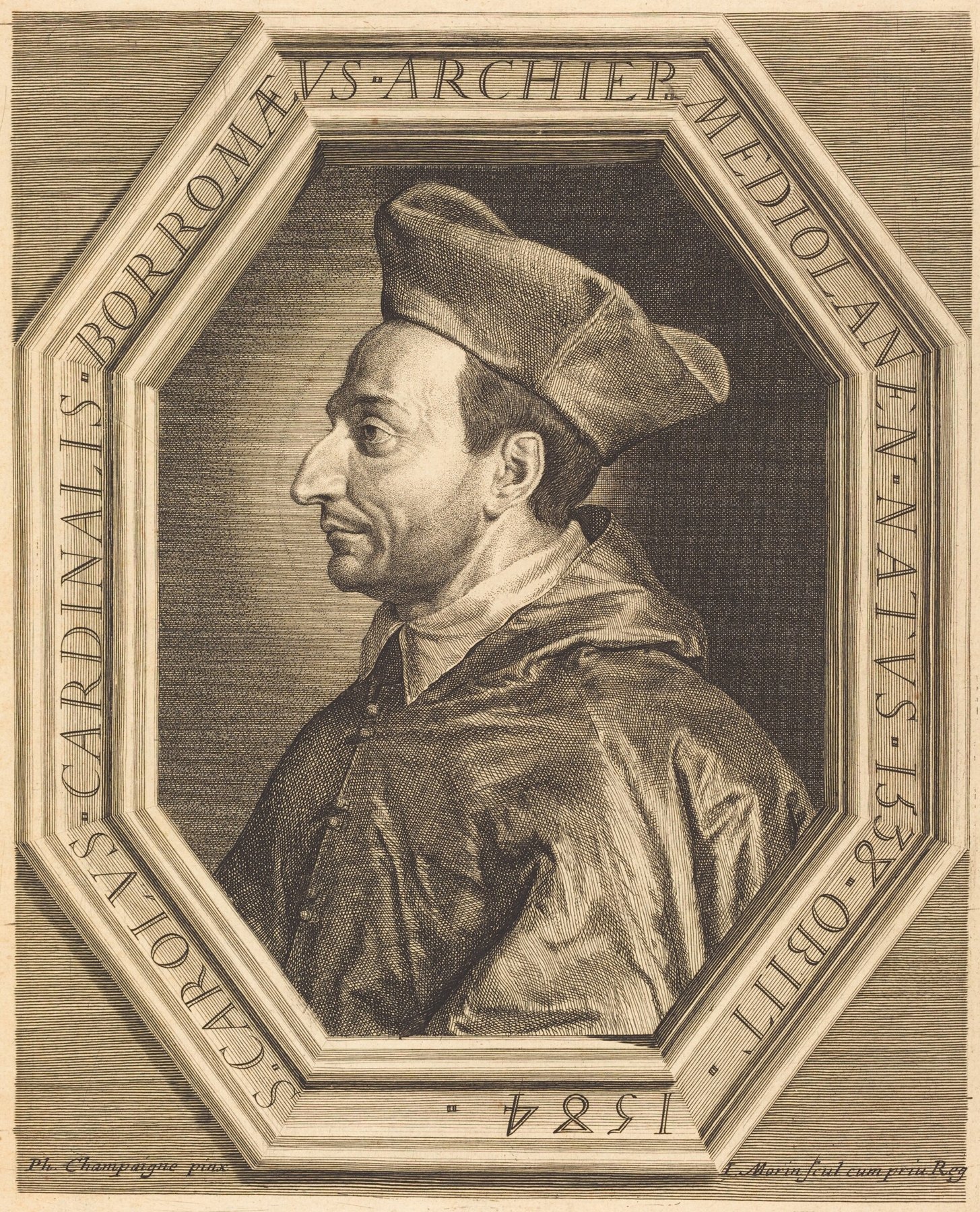
Jean Morin, after Philippe de Champaigne
before 1650, etching, engraving and stipple, National Gallery of Art, Washington, 1984.25.5
The holding institution's record
His life
He was born in the castle of Arona on Lake Maggiore on 2 October 1538, the son of Count Giberto Borromeo and Margherita de' Medici. When his uncle became Pope Pius IV, Charles was made a cardinal in January 1560 and given the vacant see of Milan to administer. He worked to bring the suspended Council of Trent together again, and after it closed was much occupied with the catechism that set out its teaching. He was ordained priest in Santa Maria Maggiore on 4 September 1563, consecrated bishop that December, and made his solemn entry into Milan on Sunday, 23 September 1565.
There he founded the Confraternity of Christian Doctrine, so that the children might be carefully and systematically taught. In 1569 a member of the Humiliati named Farina fired at him during evening prayer; he was only slightly hurt. When the plague came in 1576 he went to the stricken in their houses and in the hospital, and his presence, the Catholic Encyclopedia says, comforted the sufferers. In 1578 he founded the Oblates of Saint Ambrose, a congregation of secular priests. He died at Milan on 3 November 1584, and Paul V canonised him in 1610. He taught the children of Milan and fed it in the plague; both works are still being done tonight, and they are ours to do.
William Keogh, “St. Charles Borromeo”, The Catholic Encyclopedia, vol. 3 (1908): newadvent.org
In Scripture
11I am the good shepherd. The good shepherd giveth his life for his sheep. 12But the hireling and he that is not the shepherd, whose own the sheep are not, seeth the wolf coming and leaveth the sheep and flieth: and the wolf casteth and scattereth the sheep, 13And the hireling flieth, because he is a hireling: and he hath no care for the sheep. 14I am the good shepherd: and I know mine, and mine know me.
John 10:11–14, Douay-Rheims (Challoner).
In painting
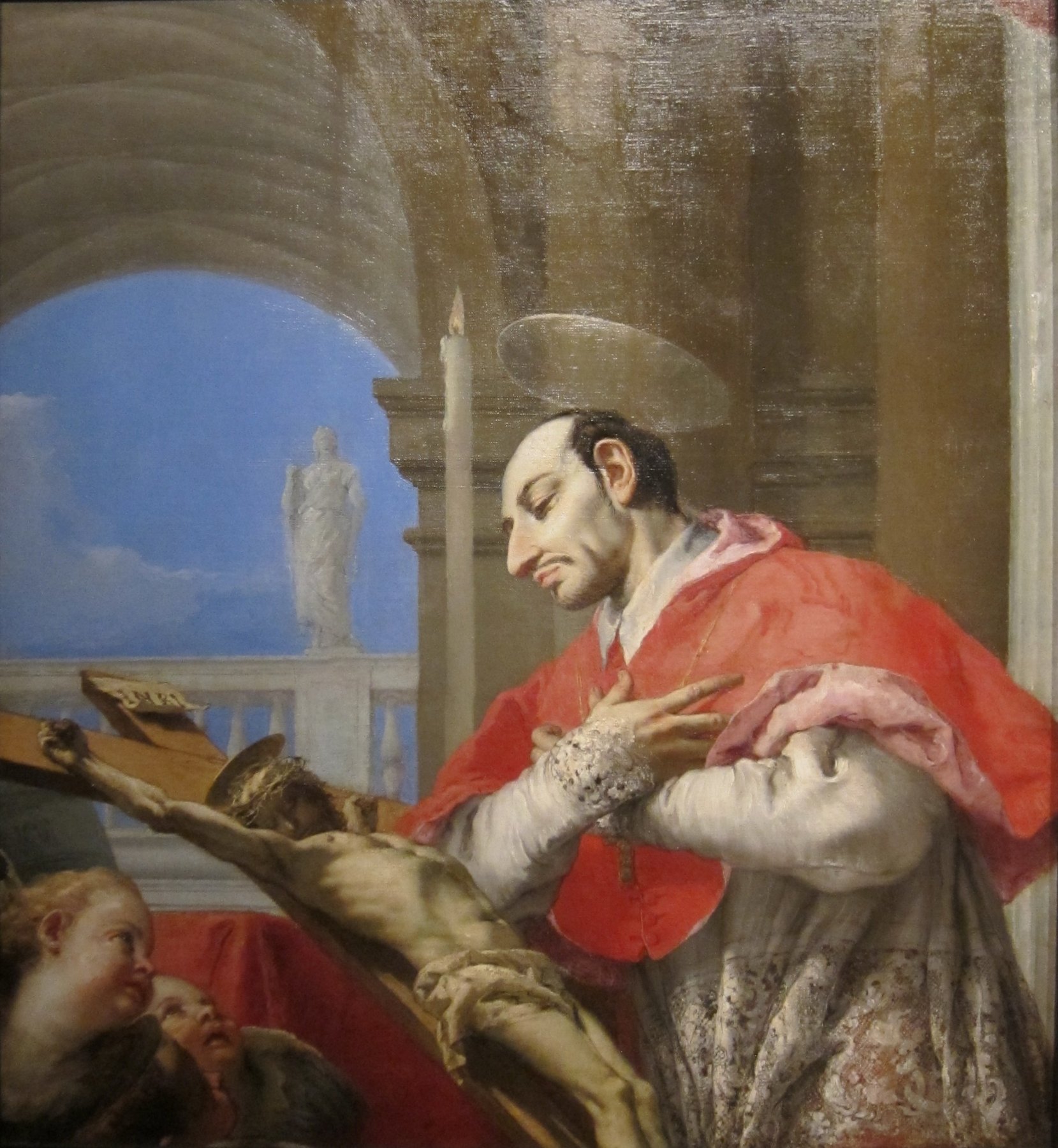
Giovanni Battista Tiepolo
1767–1769, oil on canvas, Cincinnati Art Museum, 1924.178
The photograph's record

The day in the next three years
| 2026 | Wednesday 4 November |
|---|---|
| 2027 | Thursday 4 November |
| 2028 | Saturday 4 November |
Near this day
The saints of the year · The feasts · The Rosary
Written and checked by the Monstrance editors; sources cited. Scripture in the Douay-Rheims (Challoner). Every painting is in the public domain, and each caption follows the record of the institution that holds it.
Today's masterwork, each morning
One sacred painting a day, chosen by the liturgical calendar and captioned only from the museum's record: the feast, the colour of the day, and the Scripture the scene depicts.
One confirmation email first; nothing is sent until you click it. Every email has a one-click unsubscribe, and you can switch to Sundays and feasts only at any time.