Saint Clement I
23 November · Optional Memorial · Red
In the lower church of San Clemente in Rome, beneath the church that stands there now, Clement stands at an altar with his arms raised and a book open before him, and a crown hangs in the air above the altar. Clergy crowd in from one side and courtiers from the other, and along the bottom runs the name of the man who paid for the painting more than nine hundred years ago, Beno de Rapiza, with Maria his wife.
Fresco, late eleventh century, lower basilica of San Clemente, Rome
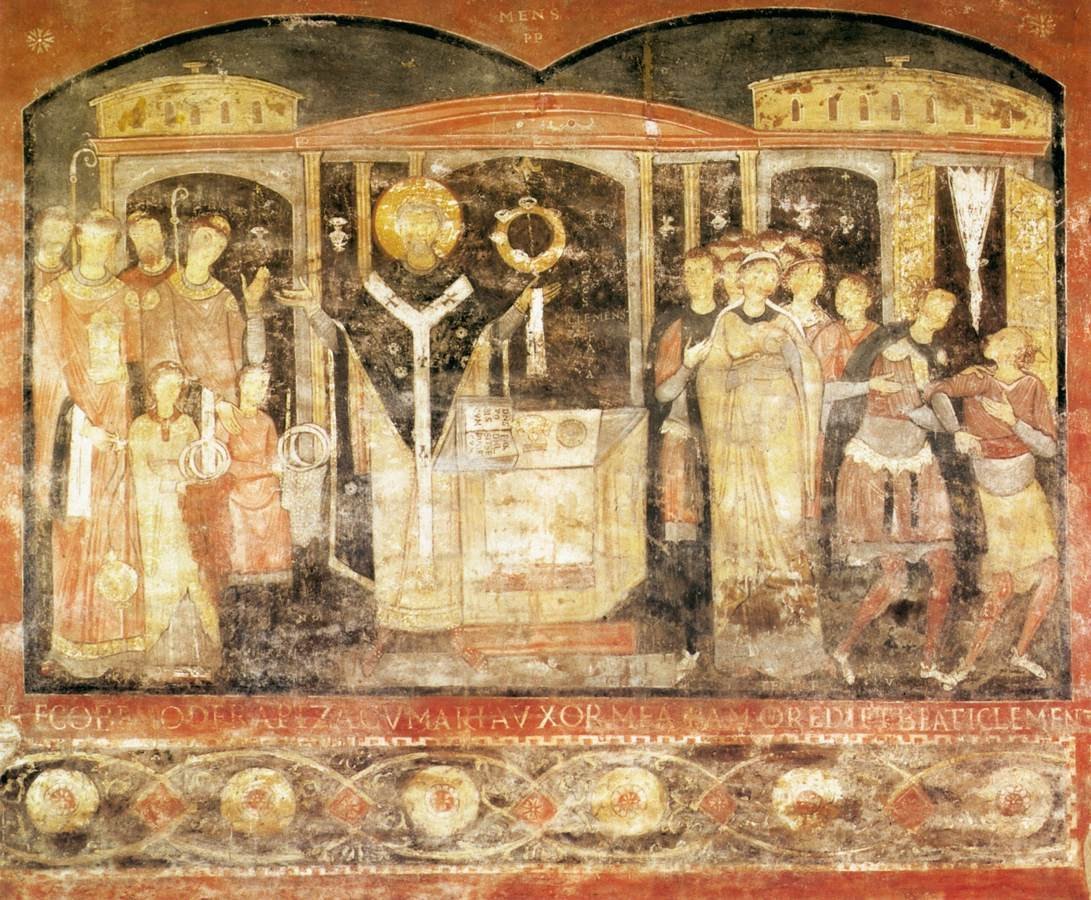
Roman painter
late 11th century, fresco, Lower basilica of San Clemente, Rome
Given by Beno de Rapiza and his wife Maria, as the inscription says.
The photograph's record

His life
Saint Irenaeus, writing about 180, gives the bishops of Rome in order: after the apostles, Linus, then Anencletus, and in the third place from the apostles Clement, who had seen the blessed apostles and been conversant with them. In his time, Irenaeus says, the Church in Rome sent a most powerful letter to the Corinthians; it survives, written about the end of the reign of Domitian, around 96. He is the first of the successors of Saint Peter of whom anything definite is known.
Later Greek Acts say that Trajan banished him to the Crimea and had him thrown into the sea with an iron anchor; the Catholic Encyclopedia notes that the story is not older than the fourth century. About 868 Saint Cyril, on his way to preach to the Khazars, dug up bones in the Crimea that were taken for Clement's, and carried them to Rome, where Adrian II received them. His church lies in the valley between the Esquiline and the Coelian, an upper church of the twelfth century built over a church of the fourth. His church in Rome is built on the church below it, and every Mass we hear still stands on the faith of the men he knew, the apostles.
Saint Irenaeus, Against Heresies III.3.3, trans. Alexander Roberts and William Rambaut, Ante-Nicene Fathers, vol. 1 (1885): newadvent.org; John Chapman, “Pope St. Clement I”, The Catholic Encyclopedia, vol. 4 (1908): newadvent.org
“Let us look steadfastly to the blood of Christ, and see how precious that blood is to God…”
Saint Clement of Rome, First Letter to the Corinthians, 7, Ante-Nicene Fathers, vol. 1 (1885): newadvent.org
In Scripture
2Feed the flock of God which is among you, taking care of it, not by constraint but willingly, according to God: not for filthy lucre's sake but voluntarily: 3Neither as lording it over the clergy but being made a pattern of the flock from the heart. 4And when the prince of pastors shall appear, you shall receive a never fading crown of glory.
1 Peter 5:2–4, Douay-Rheims (Challoner).
The day in the next three years
| 2026 | Monday 23 November |
|---|---|
| 2027 | Tuesday 23 November |
| 2028 | Thursday 23 November |
Near this day
The saints of the year · The feasts · The Rosary
Written and checked by the Monstrance editors; sources cited. Scripture in the Douay-Rheims (Challoner). Every painting is in the public domain, and each caption follows the record of the institution that holds it.
Today's masterwork, each morning
One sacred painting a day, chosen by the liturgical calendar and captioned only from the museum's record: the feast, the colour of the day, and the Scripture the scene depicts.
One confirmation email first; nothing is sent until you click it. Every email has a one-click unsubscribe, and you can switch to Sundays and feasts only at any time.