Drag the print to move it. Shown at true scale; prints are sold unframed, and a frame here is only for planning.
The Procession to Calvary
1564 (dated) · Eichenholz (oak wood) · Kunsthistorisches Museum Wien, Gemäldegalerie
For Good Friday
Sizes
What is dpi?
Dots per inch: how many pixels of the museum’s file go into each inch of paper. Our floor is 240 for sheets up to 20 inches, 180 up to 36 inches and 120 beyond, because a larger print is seen from further away. We never offer a sheet below the floor, and the number on each size is the one you receive.
Printed to order · the whole painting, never cropped · if it arrives damaged, we replace it
Free shipping, included in the price, to all eight countries we ship to. Dispatched in 2–4 working days — nothing to send back if it arrives damaged.
Send as a gift
A printed card goes in the parcel with your message and the work’s museum record. No price is shown anywhere in the parcel. Enter the recipient’s address at checkout.
0 / 240Have a gift certificate?
The certificate’s balance is applied at checkout; any remainder is paid there. Check a balance or buy one.
Christmas: order by Monday 7 December for delivery in the United States before Christmas.
All editionsAbout this painting
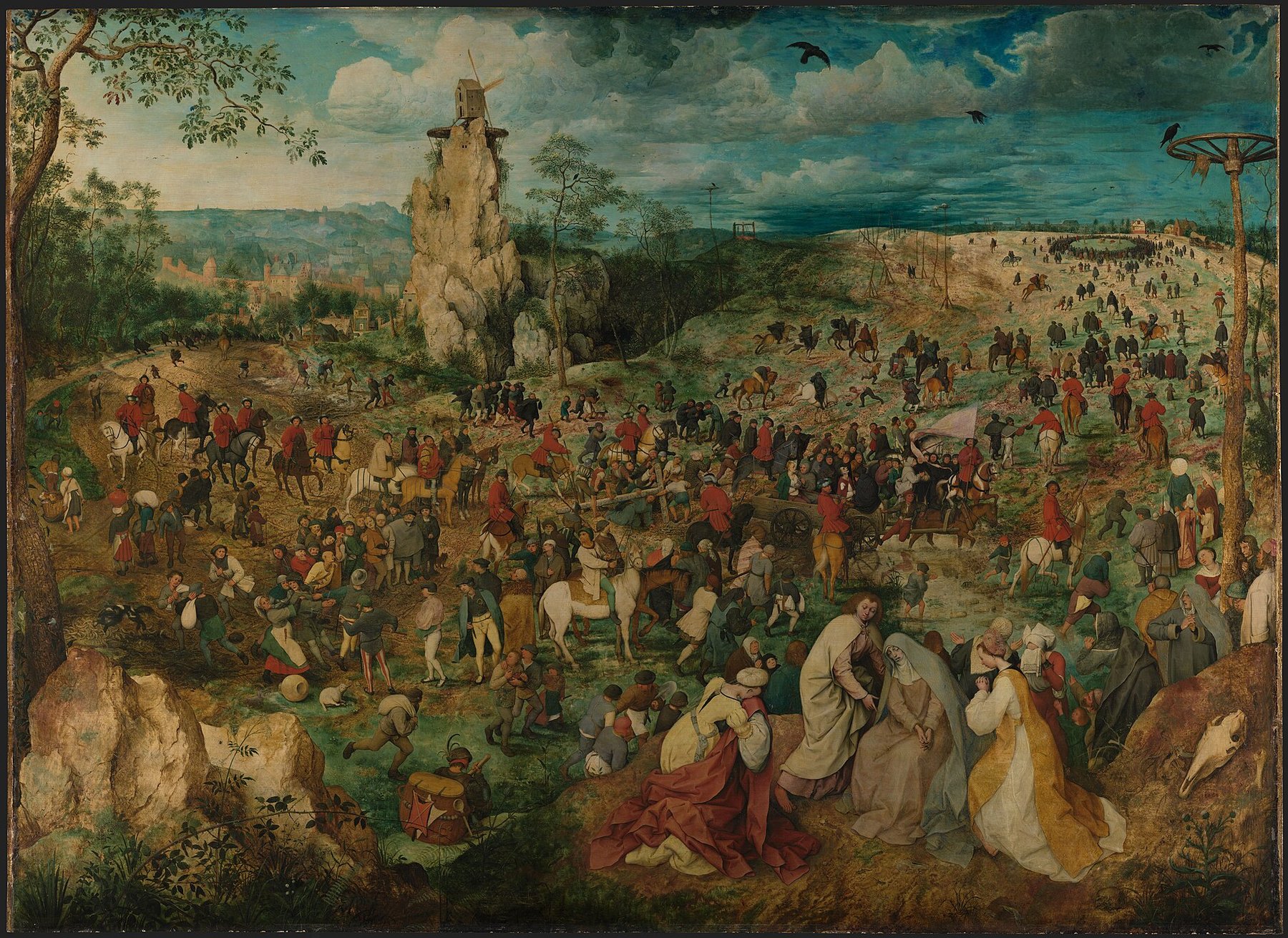
A windmill stands on a crag, crows cross the sky, and Christ has gone down under the Cross in the middle of a crowd that keeps walking. The Kunsthistorisches Museum sets Bruegel in the Netherlandish tradition of the carrying of the Cross as a procession from Jerusalem to Golgotha, extended to match contemporary life; it is his most populous painting, and only the three Marys and Saint John stand out by their dress. In the foreground Our Lady sinks into their arms. Joseph Gregory reads the suffering Christ, fixed at the centre, as a principle of stability for a world that has lost its footing. Everyone walks on around Him.
Sources: Kunsthistorisches Museum Wien, Gemäldegalerie, 'The Procession to Calvary' / 'Kreuztragung Christi', inv. 1025; read 2026-08-27. · Joseph F. Gregory, 'Toward the Contextualization of Pieter Bruegel's Procession to Calvary', Nederlands Kunsthistorisch Jaarboek 47 (1996): 206-221. Citation re-verified against the printed source line on the scan; worth one check against a library copy.
And as they led him away, they laid hold of one Simon of Cyrene, coming from the country; and they laid the cross on him to carry after Jesus.
Luke 23:26 · Douay-Rheims (Challoner)
The Record
The original, as its museum records it
Every line above is reproduced from the holding institution’s own catalogue entry, which is linked. Where their title, date or attribution differs from ours, theirs is the one printed here.
The file this print is made from
| Artist | Pieter Bruegel d. Ä. (um 1525/30 Breugel oder Antwerpen? - 1569 Brüssel) |
|---|---|
| Date | 1564 (dated) |
| Museum | Kunsthistorisches Museum Wien, Gemäldegalerie |
| Accession | Gemäldegalerie, 1025 |
| Medium | Eichenholz (oak wood) |
| Dimensions | Bildmaß: 124,3 × 170,6 × 1 cm; Rahmenmaße: 145,2 × 191,3 × 10,5 cm |
| Sheet sizes | 18×24 in, 24×36 in, 32×48 in, 40×60 in |
| Held by | Kunsthistorisches Museum Wien, Gemäldegalerie · Gemäldegalerie, 1025 the museum’s record |
|---|---|
| Source file | Wikimedia Commons · The Procession to Calvary (Bruegel).jpg |
| Licence | Public domain |
| Master | 21,291 × 15,509 px, the file our printer receives |
| Chain | Taken from Wikimedia Commons on 25 August 2026; held as our print master. |
The sheets
Printed on demand. Public-domain masterwork, reproduced from a 21,291 px master of the original. The whole image is printed — never cropped to fit the sheet — so every sheet carries an archival margin, and the dimensions and resolution listed above are the ones you receive.