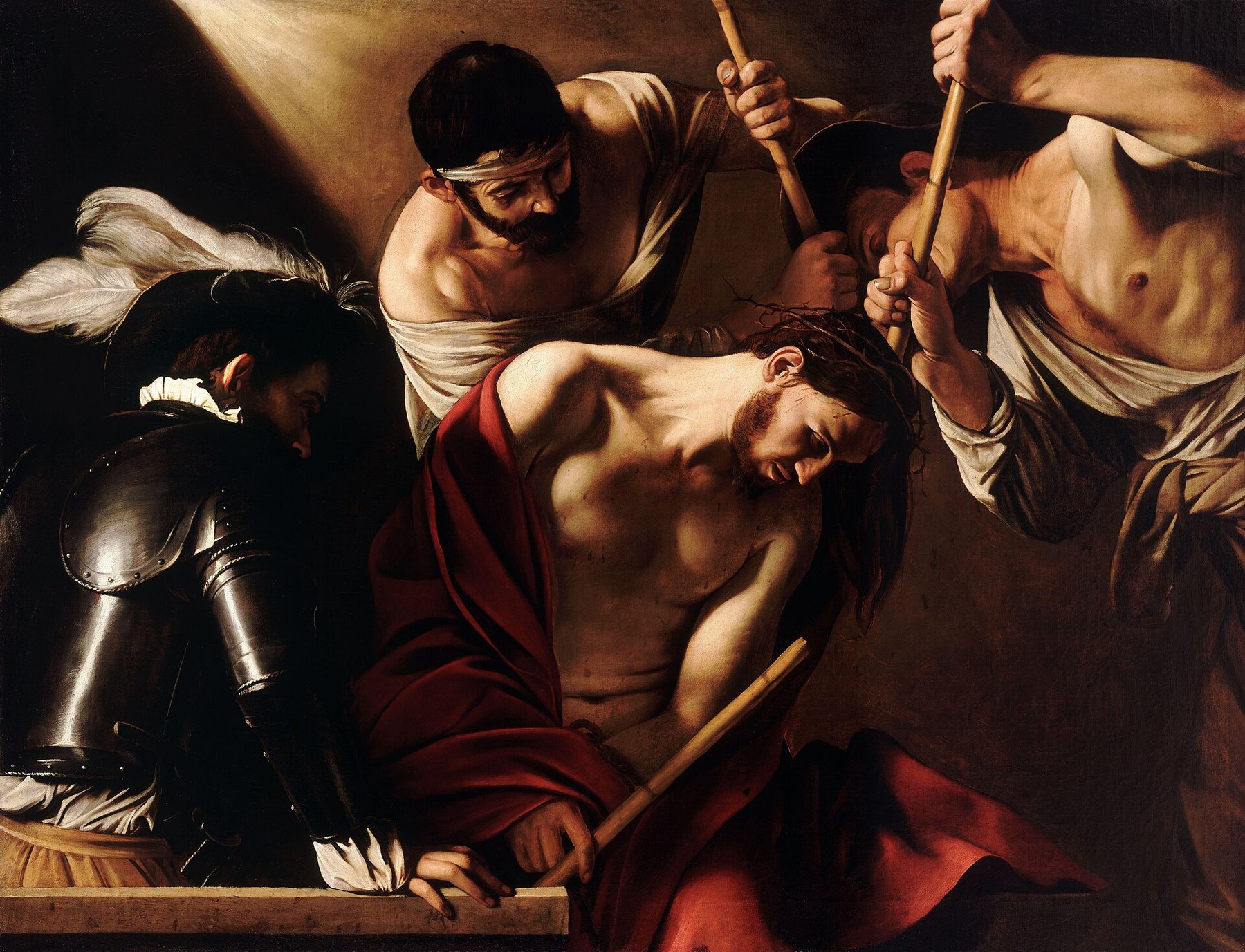
The Crowning with Thorns
The original, as its museum records it
Every line above is reproduced from the holding institution’s own catalogue entry, which is linked. Where their title, date or attribution differs from ours, theirs is the one printed here.
The file this print is made from
Sizes
Free shipping, included in the price, to all eight countries we ship to. Printed to order and dispatched in 2–4 working days. If it arrives damaged, we replace it — nothing to send back.
Christmas: order by Monday 7 December for delivery in the United States before Christmas.
View in the galleryAbout this painting
The crown is a parody of a royal diadem, not primarily an instrument of pain — thorns set upright like the rayed crowns of Hellenistic kings. Two men work it down. His neck has been forced horizontal, and the museum says that is where the brutality shows.
A man in armour watches from behind a rail and does nothing. Christ's pale skin against their weathered arms is the whole argument.
It hung over a doorway in the Giustiniani palace in Rome. The Kunsthistorisches Museum gives it to Caravaggio; the execution has been questioned in print.
Sources: GG 307, canvas, 127 × 166.5 cm, c. 1601; the neck forced horizontal; the delicate skin against the tormentors' bronzed bodies; recorded as a supraporte in the Giustiniani inventory of 1638 · the crown as a mock diadem resembling the rayed crown of Hellenistic kings, the soldiers' purpose being ridicule rather than torture · the armoured onlooker behind the rail who observes without taking part · Ferdinando Bologna, ‘Merisi, Michelangelo, detto Caravaggio’, Dizionario Biografico degli Italiani, vol. 73 (2009)
And platting a crown of thorns, they put it upon his head, and a reed in his right hand. And bowing the knee before him, they mocked him, saying: Hail, King of the Jews.
Matthew 27:29 · Douay-Rheims (Challoner)
Printed on demand. Public-domain masterwork, reproduced from a 11,037 px master of the original. The whole image is printed — never cropped to fit the sheet — so every sheet carries an archival margin, and the dimensions and resolution listed above are the ones you receive.