
 Editions
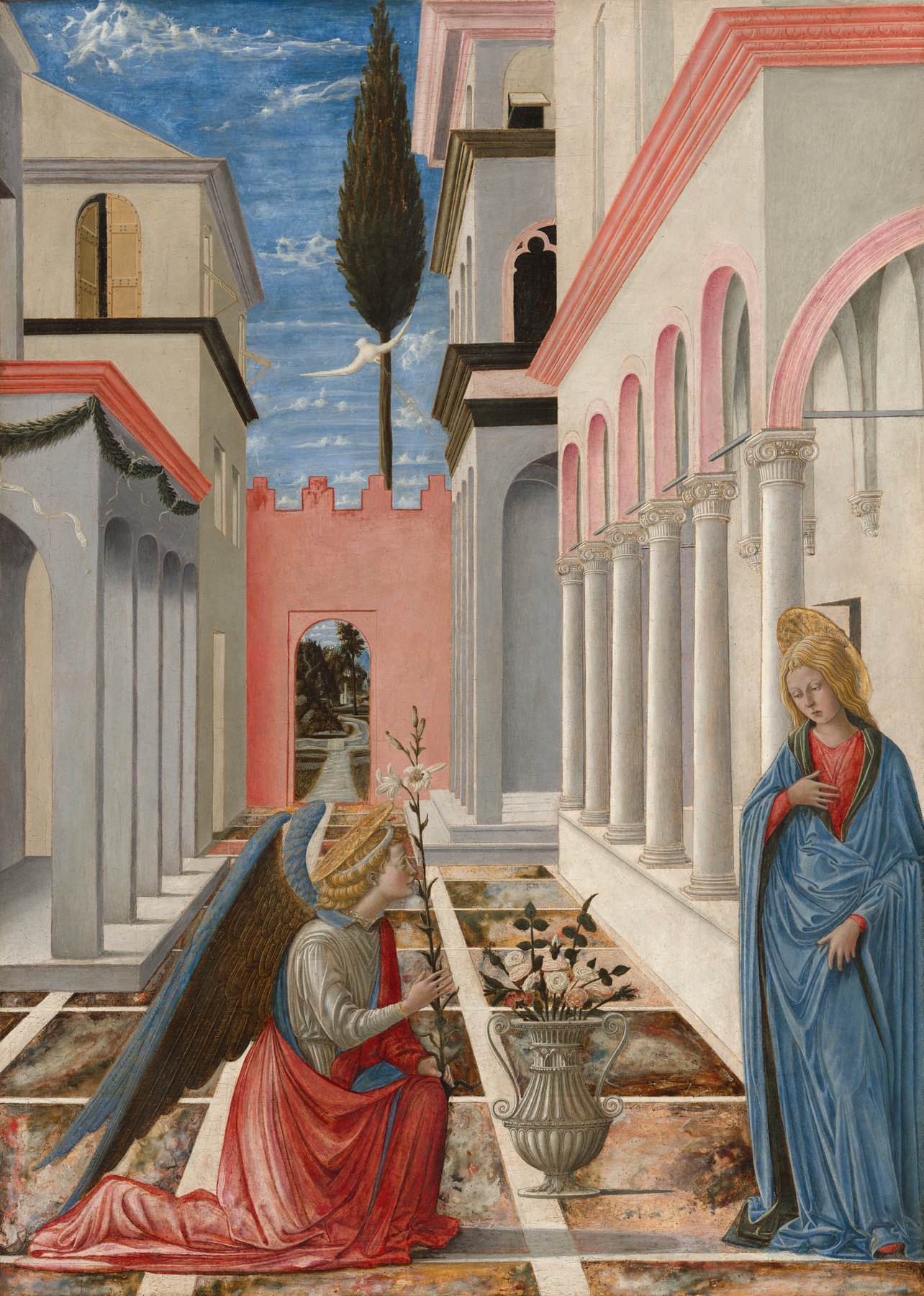
Drag the print to move it. The painting is shown at true scale; where its shape differs from the sheet the print has a paper border, not drawn here. Prints are sold unframed, and a frame here is only for planning.
The Annunciation
c. 1445/1450 · tempera on panel · National Gallery of Art, Washington
For the Annunciation · 25 March
Sizes
What is dpi?
Dots per inch: how many pixels of the museum’s file go into each inch of paper. Our floor is 240 for sheets up to 20 inches, 180 up to 36 inches and 120 beyond, because a larger print is seen from further away. We never offer a sheet below the floor, and the number on each size is the one you receive.
Printed to order · the whole painting, never cropped · if it arrives damaged, we replace it
Free shipping, included in the price, to all eight countries we ship to. Dispatched in 2–4 working days — nothing to send back if it arrives damaged.
Send as a gift
A printed card goes in the parcel with your message and the work’s museum record. No price is shown anywhere in the parcel. Enter the recipient’s address at checkout.
0 / 240Have a gift certificate?
The certificate’s balance is applied at checkout; any remainder is paid there. Check a balance or buy one.
Christmas: order by Monday 7 December for delivery in the United States before Christmas.
All editionsAbout this painting
A garden waits at the end of a street, behind an open door in a salmon-coloured wall. Our Lady stands with one hand on her breast; the angel kneels with a lily. The Web Gallery of Art finds a pinhole in the right doorjamb, eight centimetres from the base of the door, and virtually every line recedes to it. The critic John Haber reads the garden beyond as the enclosed garden of Mary's virginity, which tradition kept shut; here the portal has no gate. Annunciations belonged in bedrooms, cloisters and churches. Fra Carnevale set this one in a street of Florentine buildings, and left its door open.
Sources: National Gallery of Art, Washington, 'The Annunciation', Fra Carnevale, 1939.1.218 · National Gallery of Art, artist page, Fra Carnevale · Web Gallery of Art, Fra Carnevale, 'The Annunciation', commentary · John Haber, 'Fra Carnevale: The Making of a Renaissance Master', Haber's Art Reviews, 2005 · Samuel H. Kress Foundation, Kress Collection, 'The Annunciation', K407 · Google Arts & Culture, National Gallery of Art, 'The Annunciation', Fra Carnevale
And the angel being come in, said unto her: Hail, full of grace, the Lord is with thee: blessed art thou among women.
Luke 1:28 · Douay-Rheims (Challoner)
The Record
The original, as its museum records it
Every line above is reproduced from the holding institution’s own catalogue entry, which is linked. Where their title, date or attribution differs from ours, theirs is the one printed here.
The file this print is made from
| Artist | Fra Carnevale (Marchigian, active c. 1445–1484) |
|---|---|
| Date | c. 1445/1450 |
| Museum | National Gallery of Art, Washington |
| Accession | 1939.1.218 |
| Medium | tempera on panel |
| Dimensions | overall: 87.6 x 62.8 cm (34 1/2 x 24 3/4 in.); framed: 120 x 92.4 x 8.3 cm (47 1/4 x 36 3/8 x 3 1/4 in.) |
| Sheet sizes | 8×10 in, 11×14 in, 16×20 in, 18×24 in, 24×36 in, 32×48 in, 40×60 in |
| Held by | National Gallery of Art, Washington · 1939.1.218 the museum’s record |
|---|---|
| Source file | the National Gallery of Art’s own open-access file (IIIF) |
| Licence | public domain; the file released under CC0 |
| Master | 25,879 × 36,279 px, the file our printer receives |
| Chain | Taken from the National Gallery of Art’s own open-access file (IIIF) on 1 September 2026; held as our print master. |
The sheets
Printed on demand. Public-domain masterwork, reproduced from a 36,279 px master of the original. The whole image is printed — never cropped to fit the sheet — so every sheet carries an archival margin, and the dimensions and resolution listed above are the ones you receive.