
 Editions
Drag the print to move it. The painting is shown at true scale; where its shape differs from the sheet the print has a paper border, not drawn here. Prints are sold unframed, and a frame here is only for planning.
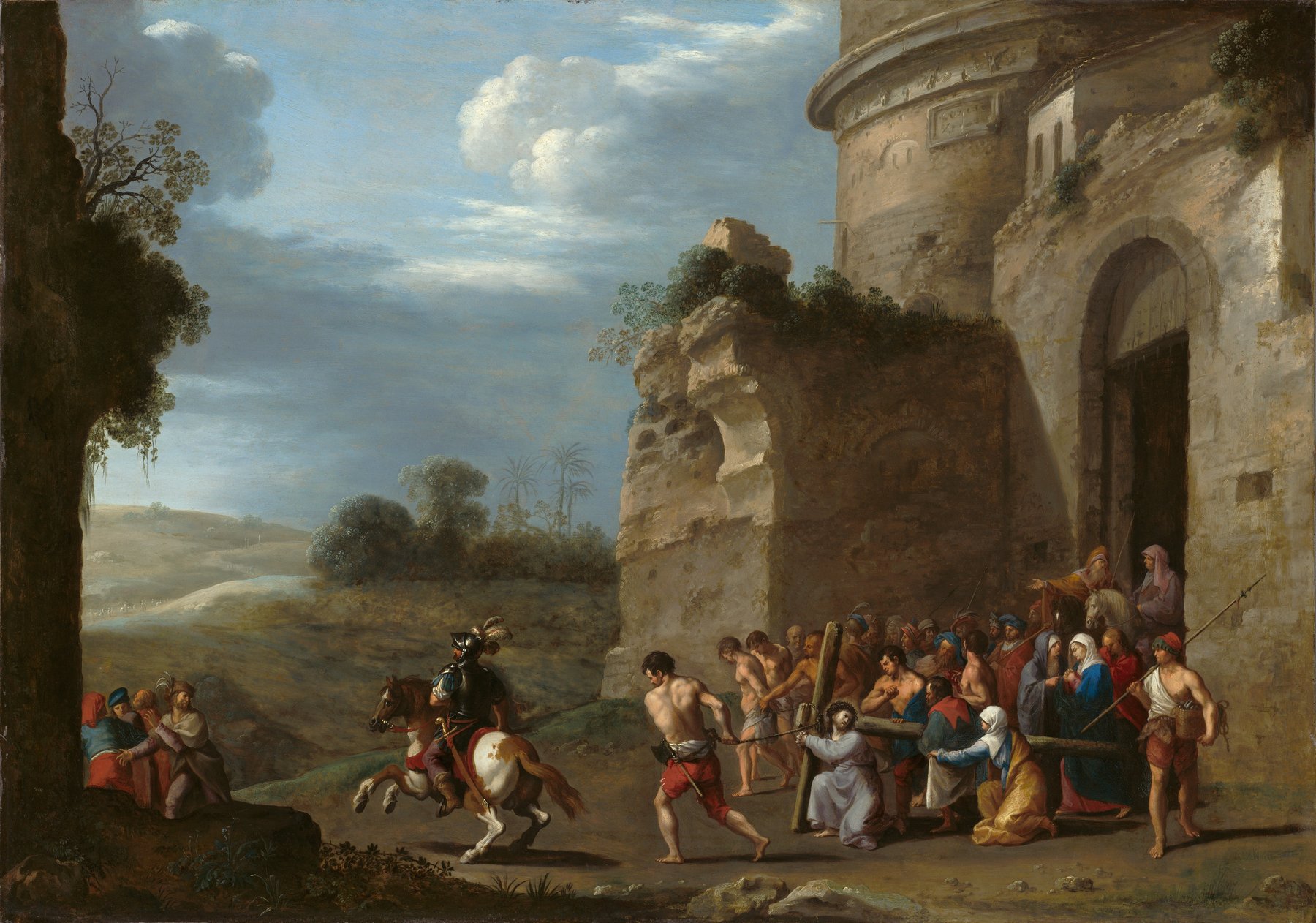
Christ Carrying the Cross
early 1620s · oil on copper · National Gallery of Art, Washington
For Good Friday
Sizes
What is dpi?
Dots per inch: how many pixels of the museum’s file go into each inch of paper. Our floor is 240 for sheets up to 20 inches, 180 up to 36 inches and 120 beyond, because a larger print is seen from further away. We never offer a sheet below the floor, and the number on each size is the one you receive.
Printed to order · the whole painting, never cropped · if it arrives damaged, we replace it
Free shipping, included in the price, to all eight countries we ship to. Dispatched in 2–4 working days — nothing to send back if it arrives damaged.
Send as a gift
A printed card goes in the parcel with your message and the work’s museum record. No price is shown anywhere in the parcel. Enter the recipient’s address at checkout.
0 / 240Have a gift certificate?
The certificate’s balance is applied at checkout; any remainder is paid there. Check a balance or buy one.
Christmas: order by Monday 7 December for delivery in the United States before Christmas.
All editionsAbout this painting
Christ is down on one knee under the Cross, and the road runs out of a tomb. The procession comes through the arched doorway of a great round ruin, and the ruin is real: the National Gallery of Art identifies it as the Tomb of Cecilia Metella on the Appian Way. Arthur Wheelock reads the choice as deliberate, the tomb's association with death used to sharpen the story, the procession passing through it on the way to Golgotha just as darkness starts to settle over the land. The NGA describes Christ looking back at the kneeling Veronica with her cloth, John covering his eyes with his red sleeve, and Longinus leading on a rearing horse; Wheelock notes that Veronica comes from the Golden Legend, not the Bible. Cornelis van Poelenburch keeps the figures small in a wide Italian landscape. Golgotha is still a long way off.
Sources: National Gallery of Art, Washington, 'Christ Carrying the Cross', Cornelis van Poelenburch, early 1620s, 2007.49.1, The Lee and Juliet Folger Fund; read 2026-09-01. · Arthur K. Wheelock Jr., 'Cornelis van Poelenburch, Christ Carrying the Cross, early 1620s', Dutch Paintings of the Seventeenth Century, NGA Online Editions, published 24 April 2014
And bearing his own cross, he went forth to the place which is called Calvary, but in Hebrew Golgotha.
John 19:17 · Douay-Rheims (Challoner)
The Record
The original, as its museum records it
Every line above is reproduced from the holding institution’s own catalogue entry, which is linked. Where their title, date or attribution differs from ours, theirs is the one printed here.
The file this print is made from
| Artist | Cornelis van Poelenburch (Dutch, 1594/1595–1667) |
|---|---|
| Date | early 1620s |
| Museum | National Gallery of Art, Washington |
| Accession | 2007.49.1 |
| Medium | oil on copper |
| Dimensions | overall: 44.2 x 62.3 cm (17 3/8 x 24 1/2 in.) |
| Sheet sizes | 16×20 in, 18×24 in, 24×36 in |
| Held by | National Gallery of Art, Washington · 2007.49.1 the museum’s record |
|---|---|
| Source file | the National Gallery of Art’s own open-access file (IIIF) |
| Licence | public domain; the file released under CC0 |
| Master | 6,359 × 4,460 px, the file our printer receives |
| Chain | Taken from the National Gallery of Art’s own open-access file (IIIF) on 1 September 2026; held as our print master. |
The sheets
Printed on demand. Public-domain masterwork, reproduced from a 6,359 px master of the original. The whole image is printed — never cropped to fit the sheet — so every sheet carries an archival margin, and the dimensions and resolution listed above are the ones you receive.